- Khamenei first became president on October 9, 1981, coincidentally three days after Egypt’s president Anwar Sadat was assassinated on the anniversary of the Yom Kippur War, for having made peace with Israel. Sadat had been a good friend of the Shah, who had died in Egypt the year before. The Oct 7th, 2023 attacks occurred one day after the Yom Kippur War’s 50th anniversary. And Israel did try to kill Khamenei in response, at least according to Israel’s defense minister.
Because the Jewish calendar is lunisolar while the Islamic is lunar, most people don’t realize that Yom Kippur and Ashura, the foremost Shia holiday, are historically the same holiday, both taking place on the 10th day (Ashura means ten) of the 1st month of their calendars. (Shia mourn the martyrdom of Muhammad’s grandson Husaynibn Ali, at the Battle of Karbala in 680 AD, while for Sunni Muslims Ashura marks the parting of the Red Sea by Moses). And both share a history of violent attacks in modern times. The last time the two holidays synced up, in 2016, bombings of Shia shrines in Afghanistan killed 30+ people, while in Iraq the Battle of Mosul, against the Shia-hating Islamic State, was just beginning, and Iraq’s (Shia) prime minister was feuding with Turkey over Turkey’s insistence that Turkish forces be included in retaking the city, Iraq’s second largest.
Before 2016, the two holidays last synced up in 2005. That was one year after a major attack on Ashua occurred, near the start of the Iraqi civil war, when bombings led to 171 deaths of Shia worshipers in Karbala and Baghdad. This repeated in 2007, when 60+ Shia were killed. The Arba’een (Forty) pilgrimage to Karbala, at the end of Ashura’s 40-day mourning period, was banned during Saddam’s rule, but has since become the world’s largest annual pilgrimage.
A constitutional referendum in Iran following the Iranian revolution was also held during Ashura, in 1979. On Ashura in 1994, a bombing carried out by MEK and/oral Qaeda members including Ramzi Yousef, at Iran’s shrine to the eighth Imam of Shia Islam, killed 25+ people in Mashhad in northeast Iran, the country’s second largest city and hometown of Supreme Leader Khamenei, among others. In 2010, on Tasua (Nine), the day before Ashura, suicide bombings at the Imam Husain mosque in southeastern Iran, carried out by Sunni Balochis, killed at least 38 people. - Balochistan:
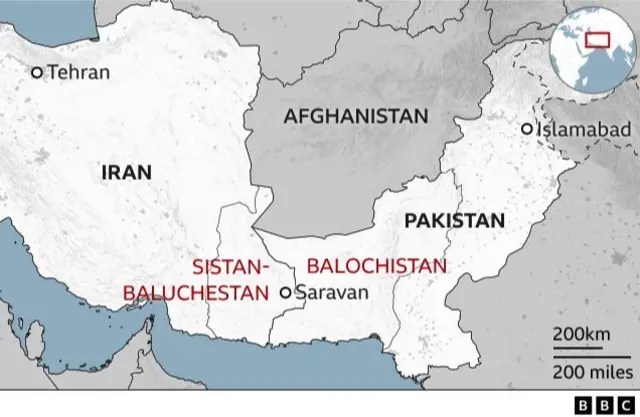
Iran’s political leaders have lately been discussing a grand, unlikely plan tomove the country’s capital away from Tehran, to the opposite end of the country along southeast Iran’s desert sea coast. This plan is made only slightly plausible as a result of rapidly falling desalination costs, but it remains far-fetched all the same. One reason (of many) it is unlikely is the threat from Balochi militants:
Balochis, the primarily Sunni inhabitants of the mountainous region spanning the borders between Pakistan, Iran, and Afghanistan, have been involved in significant attacks of late. According to Chatham House, in Pakistan, in March 2025, “Baloch separatists hijacked a passenger train carrying more than 400 people travelling from Quetta to Peshawar…Responsibility for the attack was claimed by the militant Baloch Liberation Army (BLA). The subsequent siege, near the Bolan Pass in a remote part of Pakistan’s southwestern province of Balochistan ended – apparently without mass casualties – after a 36-hour stand-off between the hijackers and army special forces. But some lives were lost. According to Pakistani military sources, at least 31 people, including civilians and security personnel, as well as 33 militants, were killed in the action. However, the BLA has disputed these figures claiming that it took 214 hostages and killed them all.”
In southeast Iran, when a Balochi suicide bombing in 2019 killed at least 27 soliders, Khamenei and other leaders publicly blamed the US, Israel, Saudi Arabia, and the UAE as being behind the attack. In 2018 , according to Wikipedia, “eleven Iranian border Guards were kidnapped by the group, with only five of them later released”. Insurgencies in this region go back decades, and include the cross-border smuggling of diesel fuel from Iran and opium from Afghanistan.
On the Pakistani side of the border, attacks by Baloch militants and suicide bombers, have often targeted Chinese nationals. According to the Australia Broadcasting Corporation, “Nearly 100 Chinese nationals have been killed in Pakistan in recent years amid local discontent over the failure of China-backed infrastructure projects”. Attacks have also targeted Shia, who are an estimated 10-15% of the population in both Pakistan and Afghanistan.
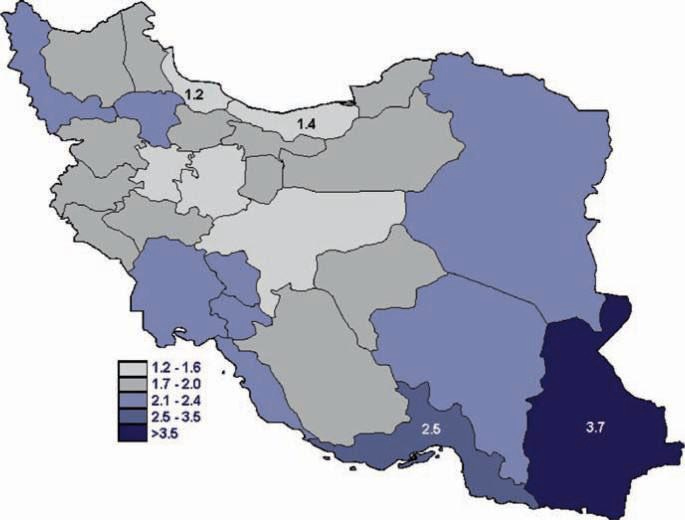
Iran, fertility rate by province. In Sistan-Baluchistan in the southeast (population 3-4 million),fertility rates are closer to those in Pakistan and Afghanistan than to the rest of Iran. An estimated 15 million Balochis live across Iran, Pakistan, and Afghanistan, with most living in Pakistan and perhaps one-third living in Iran
“In 2024, Iran carried out a series of missile and drone strikes within Pakistan’s Balochistan province, claiming that it had targeted the Iranian Baloch Sunni militant group Jaysh al-Adl. The incident occurred one day after Iran carried out a similar series of aerial and drone strikes within Iraq and Syria, claiming that it had targeted the regional headquarters of the Israeli intelligence agency Mossad within Iraqi semi-autonomous Kurdish region and several strongholds of terrorist groups, in Taltita, Syria, in response to the Kerman bombings on 3 January, for which the Islamic State took responsibility and December 2023 killing of IRGC general Seyed Razi Mousavi.”
- From an article by Seymour Hersh in The New Yorker in 2008, when US was believed to be funding groups like the Baloch: “The U.S. is overestimating ethnic tension in Iran.” The minority groups that the U.S. is reaching out to are either well integrated or small and marginal, without much influence on the government or much ability to present a political challenge, Nasr said. “You can always find some activist groups that will go and kill a policeman, but working with the minorities will backfire, and alienate the majority of the population.”….The Baluchis are Sunni fundamentalists who hate the regime in Tehran, but you can also describe them as Al Qaeda,” Baer told me. “These are guys who cut off the heads of nonbelievers—in this case, it’s Shiite Iranians. The irony is that we’re once again working with Sunni fundamentalists, just as we did in Afghanistan in the nineteen-eighties. Ramzi Yousef, who was convicted for his role in the 1993 bombing of the World Trade Center, and Khalid Sheikh Mohammed, who is considered one of the leading planners of the September 11th attacks, are Baluchi Sunni fundamentalists….The C.I.A. and Special Operations communities also have long-standing ties to two other dissident groups in Iran: the Mujahideen-e-Khalq, known in the West as the M.E.K (aka The People’s Mojahedin Organization of Iran)., and a Kurdish separatist group, the Party for a Free Life in Kurdistan, or PJAK” .
It is not clear whether or not Hersh’s statements about a US relationship with Balochi groups in Iran are actually true.
But Balochi attacks were common during this period. According to a US state department report:
“In March 2006, Jundallah attacked a motorcade in eastern Iran, which included the deputy head of the Iranian Red Crescent Security Department, who was taken hostage. More than 20 people were killed in the attack. The governor of Zahedan, his deputy, and five other officials were wounded, and seven others were kidnapped in the attack. In May 2006, Jundallah barricaded a road in Kerman province and killed 11 civilians and burned four vehicles. The assailants then killed another civilian and wounded a child by firing at a passing vehicle. In 2007, Jundallah killed 18 border guards on the Iranian-Afghan border. Jundallah seized 16 Iranian police officers near the border with Pakistan in 2008. When the Iranian government refused to release 200 Jundallah prisoners in exchange for the hostages, Jundallah killed them. In May 2009, Jundallah attacked the crowded Shiite Amir al-Mo’menin mosque in Zahedan, destroying the mosque and killing and wounding numerous worshipers. An October 2009 suicide bomb attack in a marketplace in the city of Pishin in the Sistan va Balochistan province, which killed more than 40 people, was reportedly the deadliest terrorist attack in Iran since the 1980s. In a statement on its website, Jundallah claimed responsibility for the December 15, 2010 suicide bomb attack inside the Iman Hussein Mosque in Chabahar, which killed an estimated 35 to 40 civilians with 60-100 wounded. In July 2010, Jundallah attacked the Grand Mosque in Zahedan, killing approximately 30 and injuring an estimated 300”.
Around the same time, there were reports claiming that Mossad agents posed as American intelligence in order to work with Baloch groups in Pakistan.
- In 2018, Iranians were accused of being behind an attempt to blow up a MEK meeting outside Paris, at which Rudy Giuliani was attending. In 2017 and 2018, according to Alex Vatanka, figures like Giuliani, John McCain, and several other US senators visited the MEK leadership “at their displaced persons camp in Albania. McCain told Maryam Rajavi, the MEK leader, that ‘Someday, Iran will be free’”. This relationship was not surprising, given their mutual enemy in Iran, but it is interesting, considering MEK’s Marxist origin, its attacks on Americans in Iran throughout the 1970s prior to the revolution, and its close alliance with Saddam Hussein.
- From the Middle East Forum, in 2025: “It is a mistake, however, to interpret ethnicity in Iran the same way as in the United States or Europe. In Iran, ethnicity is fluid, especially among larger ethnic groups like the Azeris who assimilate and inter-marry more…Relatedly, the Azeris who performatively call themselves pan-Turkic reveal their actual allegiances at national [football] games when they support Iran during matches with Azerbaijan or Turkey….While some analysts in Washington—mostly those who rely on Azerbaijani patronage—exaggerate Azeri nationalism in Iran, they ignore an inconvenient truth: Not only is Khamenei part Azeri, but the most brutal unit of the Islamic Revolutionary Guard Corps is overwhelmingly staffed by ethnic Azeri officers and rank-and-file. The Iranian regime regularly uses their Azeri Revolutionary Guardsmen to crush Kurdish dissent in northwestern Iran, because Khamenei knows that the Azeris will be more brutal in their attacks on Kurds (and other minorities) than the predominantly Persian units would be”.
- Alireza Farshi, whose father was killed in the Iran-Iraq War, is in prison currently, for protesting in favour of teaching schoolchildren in Azeri Turkish in northwest Iran’s Azeri provinces.
- The IRGC commander in chief from 1981-1997, Mohsen Rezaee (who was removed from the job by president Khatami, and who more recently was runner up in the 2021 presidential elections, losing to Raisi), and his successor from 1997-2007, Yahya Safavi (who put down 1999 student protests, which had been supportive of Khatami’s reform movement), and hissuccessor from 2007-2019, Mohammad Ali, are all alive today. But Ali’s successor, Hossein Salami, was killed by Israel this year. Rezaee is from Iran’s ethnic Lurminority, as was IRGC Quds force commander Qassem Soleimani. Safavi is Azeri.
- The 1979 Kurdish rebellion in Iran “was one of the largest nationwide uprisings in the country against the new state following the Iranian Revolution. The Kurdish rebellion began in mid-March, just two months after the Revolution ended, and was one of the most intense Kurdish rebellions in modern Iran”, according to Wikipedia.
- Notes from A Few Years Back: 1979
Others believed Shia revolutionaries in Iran were behind the siege [of the Grand Mosque of Mecca, in 1979]. This may have led to an uprising in the Eastern Province of Saudi Arabia, where the country’s Shia minority population lives and most Saudi oil is located. People there had been attempting to celebrate Ashura on November 25, the major holiday for Shia that had been mostly prohibited in Saudi Arabia. A week later, during that same Ashura, Iran held a referendum to ratify the constitution of its new Islamic Republic, which Khomeini had declared following his success in an earlier referendum held in March
1979 was also the year in which Israel first attempted to prevent a rival country, Iraq, from developing nuclear power. In April, in southern France, Israeli agents used explosives to sabotage a reactor that was about to be shipped to Iraq. A little over a year later, in Paris, they assassinated an Egyptian scientist who was leading Iraq’s nuclear programme…Finally, Israel attacked the Iraqi reactor directly in 1981.
Iran too carried out a significant assassination in Paris in December 1979, killing Shahriar Shafiq, a son of the Shah’s twin sister. Shafiq had been the highest-ranking royal in the Iran military, and the last to leave Iran during the revolution. In Paris in 1980, the Iranians also attempted to kill Shapour Bakhtiar, the last pre-revolutionary prime minister of Iran. He had been an opponent both of the Shah’s regime and of Khomeini. That attempt was a failure, but they later did assassinate him in Paris in 1991.
…Less than a year after the Shia-inhabited oil-rich Eastern Province uprising in Saudi Arabia, a kind of mirror-image event occurred in Iran’s Arab-inhabited oil-rich Khuzestan province, during the Iranian revolution.
- According to Wikipedia, “On 22 September 2018, a military paradewas attacked by armed gunmen in the southwestern Iraniancity of Ahvaz[Khuzestan’s capital]. The shooters killed 25 people, including soldiers of the Islamic Revolutionary Guard Corps(IRGC) and civilian bystanders It was the deadliest terrorist attackin Iran since the [Balochi] Chabahar suicide bombingin December 2010 [and the deadliestunrest in Khuzestansince 2005]. The parade was part of an annual commemoration known as the Sacred Defence Week commemorating the start of the Iran–Iraq Warin 1980. It included the Islamic Revolutionary Guard Corps marching along Quds [Jerusalem] Boulevard in Ahvaz. Five gunmen began shooting at the parade from a nearby park on 22 September 2018 at 09:00 local time wearing military uniforms and disguised as Islamic Revolutionary Guards Corps and Basiji…The Islamic State claimed responsibility for the attack and released purported photos of the attackers.Fars News Agency, described by news media to be a “semi-official” news agency of the Government of Iran, published a video threatening the capitals of Saudi Arabia and the United Arab Emirates with missile attacks by showing a graphic video of rifle scope closing in into the two cities. The video was published as Khamenei blamed Riyadh and Abu Dhabi for the attack”. Iran and the Houthis in Yemen (who have been fighting the Saudis since 2015) carried out a significant attackon Saudi oil facilities one year later.
According to Kyle Orton, “the aftermath of the 2018 Ahvaz attack was quite similar to what happened after the Shah Cheragh attack in 2022, in terms of the doubt that the Islamic State was really responsible, and the waters were muddied further when the separatist Arab Struggle Movement for the Liberation of Ahwaz initially took responsibility, only to repudiate the claim soon after…The only other Islamic State attack there has been in Iran was on 7 June 2017, when two Islamic State suicide bombers blew themselves up at the mausoleum of Ayatollah Ruhollah Khomeini [in Tehran], and gunmen shot up the nearby Majles (parliament). The twin attacks killed at least twelve people and wounded forty-two.” (Those 2017 terror attacks occurred a day after the beginning of the crisis between the Saudis and Qataris–the latter backed by Turkey and Iran–and two days before the destruction of the Great Mosque of al-Nuri, where, among other things, the Islamic State declared their caliphate in 2014, during Iraq’s Battle of Mosul).
- Protests also occurred in Khuzestan in April 2011, during the Arab Spring and on the anniversary of the province’s 2005 unrest. The Arab Spring in general impacted Iran in a number of ways: First, it risked spreading into Iran, not just via Arabs in Khuzestan but also through unrest in the country at large, which was already in the middle of its Green Movement protests. Second, it led to the Syrian civil war, in which Bashar al Assad was forced to rely on support from Iran, Hezbollah, and Russian. It also caused the ouster of President Saleh in Yemen, which became an Iranian-Saudi proxy war, eventually leading to Saudi and Emirati military intervention in 2015. Finally, it led Saudi Arabia and the UAE to send forces to Bahrain – an island claimed by Iran until 1971 – in order to assist Bahrain’s Sunni monarchy against protestors from its Shia majority.
According to the Washington Institute, this may have contributed to the failed 2011 plot to assassinate the Saudi ambassador at a restaurant in Washington and then bomb both the Saudi and Israeli embassies: “The deployment of Bahraini Defense Force tanks, backed by Saudi Arabian and UAE forces, caused shock and anger among Bahraini Shi`a and among the Shi`a leadership and people of Iran and of Iraq. There is some indication that the Iranian leaders regretted not being in a position to support the Bahraini Shi`a in what might have been a decisive political action against the Sunni monarchy. It was reportedly right after the 2011 protests that Arbabsiar [one of the two Iranian nationals charged in the plot] presented himself to his cousin, a senior Quds Force official, and that the Quds Force began planning the assassination of the Saudi ambassador, Adel al-Jubeir. Gholam Shakuri, the IRGC-Quds Force officer identified by one of the plotters as being in charge of the operation, is believed by Saudi intelligence to have met with a radical Bahraini Shi`a cleric in Beirut in early 2011 before the operation began.”
Tensions with Saudi Arabia continued, even after the emergence of ISIS and its conquest of Mosul in Iraq in June 2014, and after the Iran nuclear deal pushed by Obama was signed in 2015:
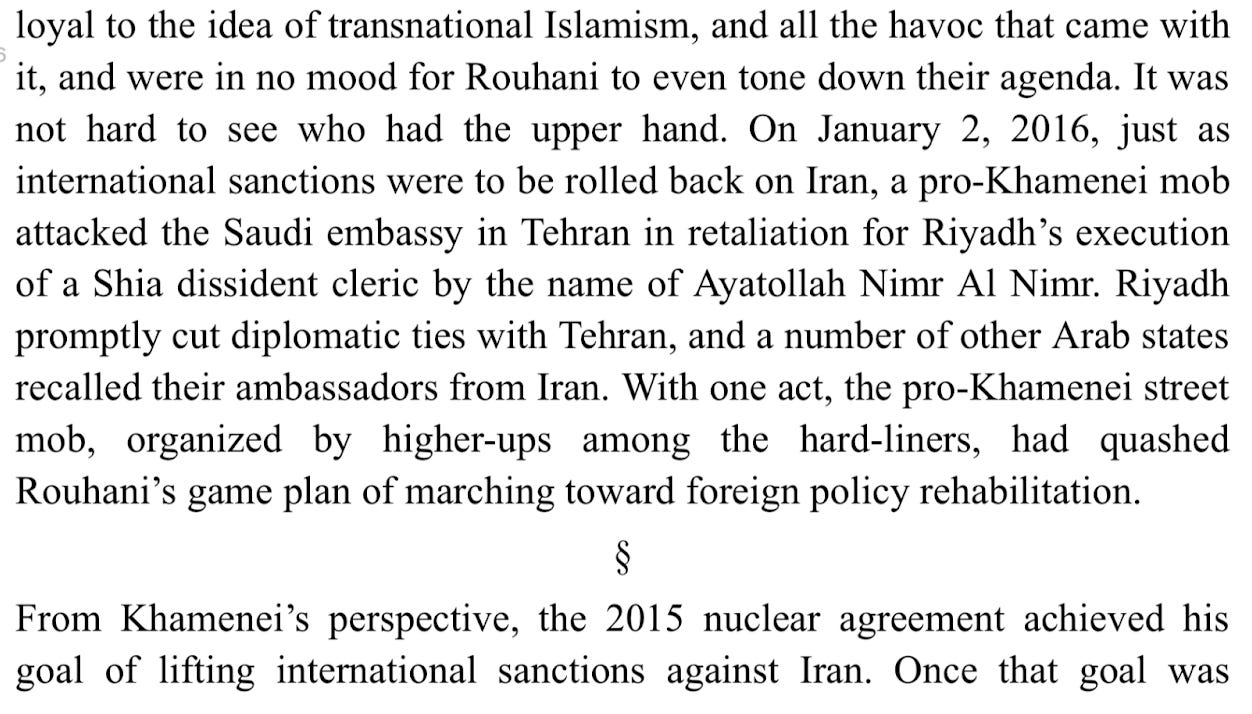
In 2017, according to this same book, “the Saudis financed the birth of Iran International, a first-class television channel with a multi-billion dollar budget, headquartered in London and operated by Iranian exiles”.
- From 2005-2013, during almost the entirety of the second oil price boom, Mahmoud Ahmadinejad was Iran’s president, the first non-cleric to hold the position since 1981. (Iran’s new president Masoud Pezeshkian, a heart surgeon, is the second). Ahmadinejad took on the Reformer camp–backed by Khamenei in doing so–but afterwards clashed intensely with Khamenei. Ahmadinejad’s close ally and son’s-wife’s-father Esfandiar Rahim Mashei tried to succeed him in the next election, but was prevented by Khamenei (via the Guardianship Council) and arrested in 2018 . Mashei, born in 1960, is yet another story of his generation rising through the Iran-Iraq war:
“Mashei started his career at the Revolutionary Guards’ intelligence unit where he joined in 1981 at 21 years old. In 1984, during the Iran–Iraq War, Mashaei joined the intelligence ministry in Kurdistan provinceand founded the Guards’s intelligence branch in the province. There he met Mahmoud Ahmadinejad, then governor (at the age of 37) of the northwestern city of Khoy…Mashaei married a former member of the People’s Mujahedin in the 1980s. Mashaei’s daughter married the former President Ahmadinejad’s oldest son in 2008.” These sorts of connections via marriageare common: Ahmadinejad’s predecessor Khatami, for example, was married to Musa al Sadr’s niece, while Khatami’s brother was married toKhomeini’s granddaughter. - This may be oversimplistic but, according to Wikipedia, Iran ranks second in proven gas reserves and fourth or fifth in proven oil reserves. Iran ranks sixteenth in the size of its working age population and eighth in primary energy production. Only China, US, Russia, and India rank ahead of Iran in both energy production and working-age population size. As of 2016 Iran had the fifth highest number of STEM graduates, behind these same four countries. A significant majority of new STEM graduates in Iran are women.
Iran’s tertiary school enrollment rates are “higher than in countries like Italy, Japan, or the United Kingdom, and twice as high as the global average. (Tertiary gross enrollment rates as reported by UNESCO.)… Reflective of the tremendous growth [in college enrollment], Iran has become home to two of the largest mega universities in the world. Iran’s massive Islamic Azad University system enrolls more than 1.7 million students. The country’s second-largest university, Payam-e-Nour University, enrolls an additional 940,000 students. Together, these two institutions alone enroll more students than the entire 2014 tertiary level student population of the country of France.” STEM subjects, especially engineering, are the most commonly studied by Iranian students. - by Ariane Bonzon in Le Monde: “The following year (2019), Israel, Cyprus, Egypt and Greece launched the East Mediterranean Gas Forum, a shared platform for the region’s suppliers, transporters and buyers of gas. The move was greeted with shock in the presidential palace in Ankara: Turkey’s prospects of becoming an energy hub were receding. ‘It was at this point that the Turkish government realised how isolated it was. In order to prevent Libya from joining the group, it signed a military cooperation agreement and a maritime boundary treaty with Tripoli,’ explains Evren Balta, international relations professor at Özyeğin University, Istanbul.
At the Negev summit in March 2022, the flags of Bahrain, Egypt, the United Arab Emirates, US, Morocco and Israel flew side by side. Saudi Arabia and the UAE had reestablished relations with Qatar, an ally of Turkey. A new Middle East seemed to be taking shape – one from which Turkey might find itself excluded. ‘Erdoğan took the initiative in the move towards normalisation,’ Liel explains. ‘The Abraham accords [2020] changed his way of seeing things: he understood that they significantly improved Israel’s position in the Middle East.’ In September 2023 Erdoğan and Netanyahu met on the sidelines of the UN General Assembly, and a visit to Ankara by the Israeli prime minister was planned. The Hamas attack on 7 October 2023 therefore came just as Turkey was preparing to normalise relations with Israel.
…By demanding sanctions against Tel Aviv at the same time as the closing of an American radar station at Kürecik used by the Israelis and even for Turkish troops to be sent to Gaza, the New Welfare Party (YRP) led by Fatih Erbakan (the son of Erdoğan’s former mentor) is gaining a growing following – including within AKP ranks. Refusing to ally with the YRP, Erdoğan is critical of the popularity of his Islamist rival, which obtained nearly 7% of the vote in elections in March 2024, depriving the AKP of two cities it had previously held”. - This year will be the 80th anniversary of the 1946 Iran crisis, often regarded as the first conflict in the Cold War. Later, the Korean War, the first major war fought directly between the US and its Cold War rivals, ended in a stalemate in July 1953 – only a few weeks before the infamous coup against Iranian prime minister Mohammad Mosadeghon August 19, orchestrated by the US and Britain. A week before the coup, the first Soviet thermonuclear weapon(boosted fission) was detonated. One day after the coup, on the eve of Eid al-Adha at the end of Ramadan, France forced the sultan of Morocco, Mohammed V, into exile in Corsica, replacing him with his first cousin once removed. (In a somewhat similar manner, Britain and the Soviet Union put the Shah on the throne, when only 22 years old, in place of his father, after their joint invasion of Iran in 1941). Moroccan nationalists and terror attacks led France to recall the sultan a year later, who then negotiated with France and Spain to gain Morocco’s independence. Around the same time, an Algerian protest in July 1953 in Paris was violently put down by the police, in the leadup to the Algerian war of independence against France, which began the following year. France also lost its war in Vietnam in 1954; Eisenhower’s domino theory speechand the start of US aid to anti-Communist forces in Vietnam was in August 1953 – again, the same month as the coup in Iran.
August 1953 also saw Ariel Sharon lead a raidinto Egyptian-controlled Gaza, in which 20-30 Palestinians were killed, before the Qibya massacrein the Jordanian-controlled West Bank in October. Egypt’s monarchy had been abolished two months earlier, a year after theEgyptian revolution, led by officersMohamed NaguibandGamal Abdul Nasser. (“In late 1953, Nasser accused Naguib of supporting the recently outlawed Muslim Brotherhood and of harboring dictatorial ambitions”, then forced him out of office).This led to the1956 Suez Crisis, when, unlike in the Iranian coup, the US backed Nasser, restraining the British-French-Israeli invasion of Egypt.
In Jordan, Hussein began his 46-year rule as king in 1953, following his father’s abdication and his grandfather’sassassinationby a Palestinian gunman at Jerusalem’s Al Aqsa Mosque in 1951. In Syria, military strongmanAdib Shishkaliwas overthrown in February 1954, byHashim al Attassi, who was backed in large part by Druzeofficers. (Shishkali was killed a decade later by a Druze assassin in Brazil). In Israel, diplomatic relations with its former ally the Soviet Union were severed after a Jewish terror groupbombed the Soviet embassy in Tel Aviv, one month before Stalin’s death in March 1953, in response to Stalin’santi-Jewish Doctors’ Plot. In Saudi Arabia, the kingdom’s founder and long-time rulerAbdulaziz Ibn Sauddied in November 1953. He died a month after oil workers in the Eastern Province, at US-owned Saudi Aramco, began the country’s firstsignificant labour strike.
A larger labour dispute, in East Germany in June 1953, turned into amass uprising against the regime, the first to occur in Europe’s Communist bloc, leading to a violent crackdown by Soviet forces. - Finally, two last excerpts from Alex Vatanka’s book The Battle of the Ayatollah’s in Iran:
 thegeographicinvestor.com