Earthquakes and other disasters

Source: Hannah Ritchie, Our World in Data

Leaving aside Covid-19, no single natural disaster in the past decade caused more than 50,000 deaths*. In the past two decades however, at least eight natural disasters have done so. The deadliest of these was most likely the Indian Ocean earthquake and tsunami in 2004, which caused an estimated 230,000 deaths, most of them in Indonesia but many also in Sri Lanka and other countries in the region. This was followed by the 2005 Kashmir earthquake (~87,000 deaths), the 2008 Burma cyclone (~138,000 deaths), the 2008 Sichuan earthquake (~88,000 deaths), the 2010 Haiti earthquake (~46,000-316,000 deaths) and a heat wave, drought, and wildfires in Russia in 2010 (~56,000 deaths). An earlier heat wave in Europe in 2003 resulted in an estimated 70,000 deaths.

*This may no longer be true. The recent earthquakes in Turkey and Syria have caused approximately 45,000 deaths in Turkey thus far, and several thousand deaths in Syria

One obvious pattern here is the destructiveness of earthquakes and earthquake-triggered tsunamis. They caused four out of these eight disasters, including the two deadliest.

Financially too, earthquakes have usually been the most devastating disasters. The most expensive natural disaster in modern history was the earthquake and tsunami in Japan in 2011, which caused approximately 20,000 deaths (very few of which were due to the Fukushima nuclear disaster, which the tsunami triggered) and resulted in an estimated 400+ billion dollars worth of damage, adjusted for inflation, according to Wikipedia. (The 2010 Northern Hemisphere heat waves, if viewed as being a single natural disaster, may have been even costlier). That same year, the Christchurch earthquake in New Zealand cost an estimated $44 billion, itself one of the most expensive modern-day disasters. The second most expensive disaster was another Japanese earthquake, in 1995 in Kobe (~6,400 deaths; ~$330 billion worth of damage). Third costliest was the 2008 earthquake in Sichuan, China (~88,000 deaths; ~$176 billion).

The five most expensive natural disasters apart from these earthquakes may all have been hurricanes in America, each one taking place since 2005 (Katrina); three taking place in 2017 alone (Harvey, Maria, and Irma). Yet even the 2017 hurricane season as a whole cost less than either of Japan’s big earthquakes.

A good source on natural disasters is Vaclav Smil‘s book Global Catastrophes and Trends: The Next Fifty Years, published in 2006. It looks closely at the dangers posed by many different types of disasters, including low-probability, high-impact events like asteroid strikes, supernovae explosions, and mega-volcanic eruptions. According to Smil, the most common disasters of late have been floods and storms, but the deadliest have been earthquakes:

Of course, these do not come near the figures of the deadliest modern epidemics, not just Covid-19 or the Spanish Flu of 1918-1920, but also others such as the 1957-1958 Asian flu (~2 million deaths), the 1968-1969 Hong Kong flu (~1 million deaths), and the AIDS epidemic (~32 million deaths in its 60 years, for an average of 530,000 deaths per year, with a peak of 1.7 million deaths in 2004, most occurring in southern Africa). Nor do they approach the number of deaths from other horrible, avoidable problems, such as road accidents (~1.3 million deaths per year in recent years), indoor air pollution (~2-4 million deaths per year), or war (~30,000-200,000 deaths worldwide per year during the relatively peaceful past decade). They also do not come near the death tolls from the very worst natural disasters, like the floods that occurred in northern China in 1887 (~900,000-2 million deaths, perhaps half of which were caused by a resulting pandemic and famine) or in 1931 (~400,000-4 million deaths).

These lists of disasters do not include food crises or famines, the causes of which are often more political than environmental. The deadliest food crises to occur in recent years were the droughts in East Africa in 2011, which resulted in an estimated 50,000-250,000 deaths, and perhaps also in the Middle East in 2011 and 2012, which may or may not have been one of the causes of the Syrian civil war. The worst cases to occur in recent decades include the famines in North Korea from 1994-1998 (~240,000-3.5 million deaths), in Ethiopia from 1983-1985 during part of its civil war (~1.2 million deaths), and above all in China from 1959-1961 during the Great Leap Forward (~15-55 million deaths).

Obviously these Wikipedia statistics need to be taken with a large grain of salt. They often range widely: the death toll estimates for the recent 2010 Haiti earthquake, for example, run from 46,000-85,000 (according to a report made by the US Agency for International Development) to 160,000 (according to a University of Michigan study) to 316,000 (based on numbers from the Haitian government). The death toll from the 1976 North China earthquake, perhaps the deadliest post-WWII natural disaster, ranges from 240,000-650,000.

All of these estimates may also overlook indirect causes of death and destruction, and certainly they do not include the significant non-fatal consequences disasters usually cause. The 2015 Nepal earthquakes, for example, led to around 8,000 deaths, but 3.5 million people were made at least temporarily homeless by them. The heat waves in Europe and Russia in the 2000s killed tens of thousands of people, but many of those who they killed were already seriously ill. The 2011 earthquake and tsunami and nuclear disaster in Japan led not only to death and destruction directly, but also to increased pollution from coal and lignite, as it caused Japan and Germany to shutter most of their nuclear power plants.

Earthquake magnitudes since 1900: https://commons.wikimedia.org/wiki/File:Map_of_earthquakes_1900-.svg

Historically speaking, northern China and Japan have suffered some of the deadliest earthquakes, though in China’s case this has had more to do with the country’s population density and other factors than with the intensity or frequency with which it tends to experience earthquakes, which has generally been lower than that faced by Japan and other countries along the Pacific rim. Before the terrible earthquakes in Sichuan in 2008 and Hebei in 1976, there was the Gansu-Ningxia earthquake in 1920 (~273,000 deaths). Three years after that, the 1923 Great Kanto earthquake in Japan caused ~100,000-143,000 deaths, destroyed large parts of Tokyo and Yokohoma, and was, at the time, probably the most destructive disaster experienced by a modern industrial city. Possibly the deadliest ever earthquake occurred in Shaanxi, in northern China, back in 1556, killing an estimated 100,000-800,000+ people.

Along with the 1976 Hebei earthquake, the other deadliest disasters in the late twentieth century were the 1991 Bangladesh cyclone (~140,000 deaths), the 1975 typhoon and resulting collapse of the Banqiao Dam in central China (~230,000 deaths) and the 1970 East Pakistan (now Bangladesh) cyclone (~500,000+ deaths). That East Pakistan cyclone, which is likely the deadliest cyclone to have ever occurred, may also have triggered Bangladesh’s war of independence the following year. The cyclone struck just one month before Pakistan’s first ever democratic election was held at the end of 1970, and the poor flood-relief efforts by the Pakistani military government in the immediate aftermath of the cyclone is thought to have helped influence a large majority of Bengalis to vote for the Bengali nationalist Awami League. This in turn led to an alleged genocide being carried out by Pakistan against Bengalis, and ultimately to a brief but deadly war being fought between India and Pakistan.

Bangladesh and the Philippines are notable here, as being arguably the most prone to natural disasters, of various kinds, of any large countries. The Philippines in particular regularly experiences earthquakes, tsunamis, cyclones, and volcanic eruptions. Even as Bangladesh suffered one of its deadly cyclones in 1991, in the Philippines that same year the eruption of Mount Pinatubo, just outside of Manila, killed 847 people and caused “the largest stratospheric disturbance since the Krakatoa eruption in 1883, dropping global temperatures and increasing ozone depletion”, according to Wikipedia. It was the second largest known eruption in the twentieth century, trailing only the eruption of Novarupta in Alaska in 1912.

At least ten times greater than these eruptions however was the Mount Tambora explosion in Indonesia in 1815, the only volcano in recorded history other than Krakatoa to result in a death toll above 30,000. The Tambora eruption is estimated to have killed 70,000-250,000+ people, mostly through its impact on the global climate: it may have caused the famines of the “Year Without a Summer” in the Northern Hemisphere in 1816. Nearby Krakatoa too killed most of its victims indirectly, by triggering what may have been the third deadliest tsunami in recorded history (~36,000–120,000 deaths). The only deadlier tsunamis were caused by the Indian Ocean earthquake in 2004 and by the Messina earthquake in Sicily in 1908 (~75,000-123,000 deaths).

Going back all the way to Mount Vesiuvus’ destruction of Pompei and Herculaneum in 79 AD, only ten volcanic eruptions are estimated to have killed more than 10,000 people — a far lower figure than the number of deadly earthquakes, storms, or famines. Since Krakatoa in 1883 there have been only two very deadly eruptions, one in Colombia in 1985 and the other on the Caribbean island of Martinique in 1902. The Martinique eruption killed all but two of the 28,000 inhabitants of the town of Saint-Pierre – one of the survivors a prisoner in a jail cell who had been arrested the previous night. The Colombia eruption resulted in an estimated 23,000 deaths, and led to the creation of the Volcano Disaster Assistance Program in the United States, which six years later helped evacuate 75,000 people from around Mount Pinatubo in the Philippines, keeping the death toll from that much larger eruption low.

Two months before the eruption in Colombia, which was the deadliest natural disaster in Colombian history, Mexico experienced the deadliest disaster in its history, the 1985 Mexico City earthquake, which caused an estimated 5,000-45,000 deaths. A number of other disasters in recent decades have had death tolls within a similar range. These include earthquakes in Gujarat, India, in 2001 (~13,000-20,000 deaths; India’s current prime minister Narendra Modi became Chief Minister of Gujarat that year, following the perceived inability of his predecessor to handle the aftermath of this earthquake), in Turkey in 1999 (~17,000 deaths; Turkey’s president Recep Tayyip Erdogan, whose government bears much of the responsibility for the high death count in last year’s earthquake, was released from prison the month before the 1999 earthquake, after having been mayor of Instabul from 1994-1998), in Iran in 1990 (~35,000-50,000 deaths, not long after the end of the Iran-Iraq War), and Armenia in 1988 (~28,000 deaths, not long after the start of the First Nagorno-Karabakh War).

Apart from earthquakes, the list of modern-day disasters with death tolls in this range also includes cyclones in Central America and Mexico in 1998 (~11,000 deaths), Bangladesh and India in 2007 (~15,000 deaths) and southeastern India in 1977 (~10,000-50,000 deaths), and flash flooding and landslides in Venezuela in 1999 (~10,000-30,000 deaths).

The United States, in contrast to these countries, has been mostly spared from deadly natural disasters. The Great Galveston hurricane in 1900 was the probably the deadliest disaster in American history, resulting in the deaths of 8,000-12,000 people. Heat waves in 1901, 1936, 1980, and 1988 may each have resulted in 1000-10,000 deaths. And the country does face a significant risk from earthquakes, particularly in the Pacific Northwest. (This Pulitzer-prize-winning New Yorker article about this topic is worth reading). Thus far however the deadliest earthquake the US has experienced, in San Francisco in 1906, resulted in a relatively low number of deaths (~700-3000). The next deadliest, in Alaska in 1946, caused 165 deaths. Alaska then experienced the world’s second-highest-magnitude earthquake of the past century, in 1964 – a magnitude 9.4 – which caused 143 deaths.

Like Alaska, certain places in the world have been struck repeatedly by large earthquakes. The most notable of these may be Valdivia, in Chile. It experienced the most powerful earthquake on record, in 1960, an earthquake so powerful that by itself it accounted for roughly 25 percent of the world’s seismic energy released in the 20th century. (The next two biggest in the century, in Alaska and Sumatra, together accounted for roughly another 25 percent). The first big earthquake recorded in modern times was also in Valdivia, in 1575, according to Wikipedia.

The next three big ones after that, all in the 1600s, were in Chile as well, including one in the capital, Santiago. Valparaiso (in central Chile, near Santiago) was then hit with big ones in 1730 and 1822, and Conception (on the coast between Valdivia and Valparaiso) in 1751 and 1835. More recently, the Chilean coast south of Valparaiso was struck by a magnitude 8.8 earthquake in 2010. It was 500 times more powerful than the earthquake Haiti had suffered through a month earlier, but, with only 500-550 casualties, it was hundreds of times less deadly.

The other area to flag in this regard is the island of Sumatra, in Indonesia. It has been hit with one of the only two recent earthquakes with a magnitude of at least 9; namely, the deadly Indian Ocean earthquake and tsunami in 2004. (The other magnitude 9+ earthquake was the costly Japan earthquake in 2011; until then most experts had not believed that an earthquake above 8.4 was even possible in Japan). Before that, no 9+ magnitude earthquakes had occurred since Alaska in 1964 or Chile in 1960. A magnitude 9 earthquake is about 33 times more seismically powerful than a magnitude 8, and over 1000 times more powerful than a magnitude 7. Sumatra was also hit by three of the only four recent earthquakes in the magnitude 8.5-to-9 range (in 2005, 2007, and 2012; the fourth was Chile’s in 2010). Before 2004, there were no magnitude 8.5+ earthquakes since Alaska in 1964.

Source: https://www.usgs.gov/programs/earthquake-hazards/earthquake-magnitude-energy-release-and-shaking-intensity

Going further back into human history, Sumatra also has the honour of being where Mount Toba erupted, around 75,000 years ago, in an explosion at least a dozen times greater than even Tambora’s was in 1815. The Toba catastrophe theory “holds that this event caused a global volcanic winter of six to ten years and possibly a 1,000-year-long cooling episode. In 1993, science journalist Ann Gibbons posited that a population bottleneck occurred in human evolution about 70,000 years ago [with fewer than 10,000 humans left alive in the world], and she suggested that this was caused by the eruption.” This theory is still debated today. It may serve as a reminder – as if we needed another one – that it pays to keep an eye on all the things that can go disastrously wrong in the world.

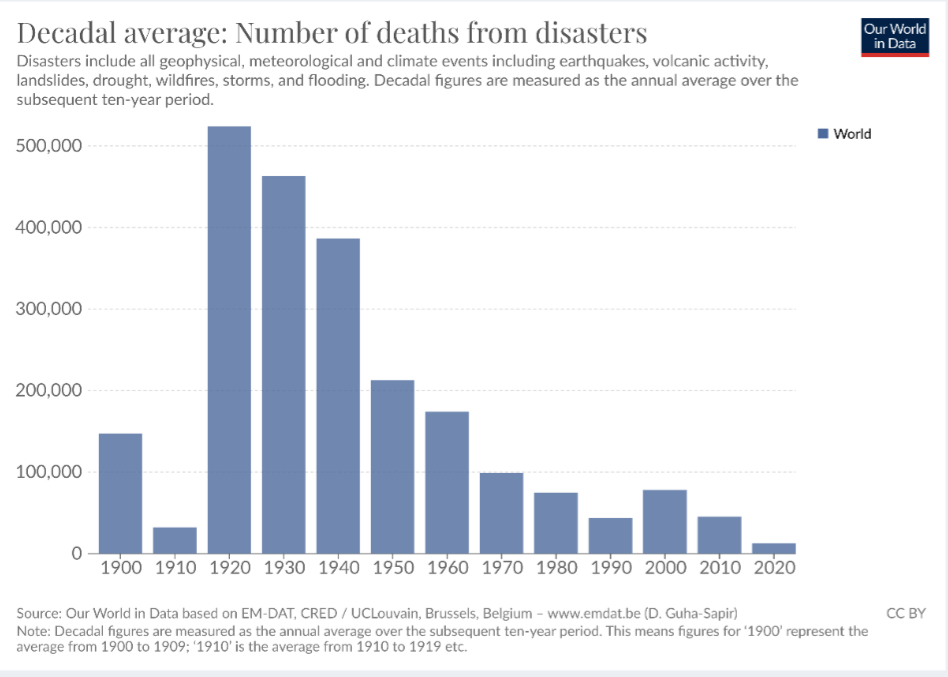
The world population during the 1920s was roughly 2 billion, rather than 8 billion today. So the per capita annual average death toll from these disasters a century ago might have been something like 50-200 times greater than it has been in recent years. Note also that during the 1970s, 1980s, and 1990s there weren’t any magnitude 8.5+ earthquakes, whereas between 2004-2012 there were six of them, two of which were magnitude 9+

Population Growth Since 1950 in North America

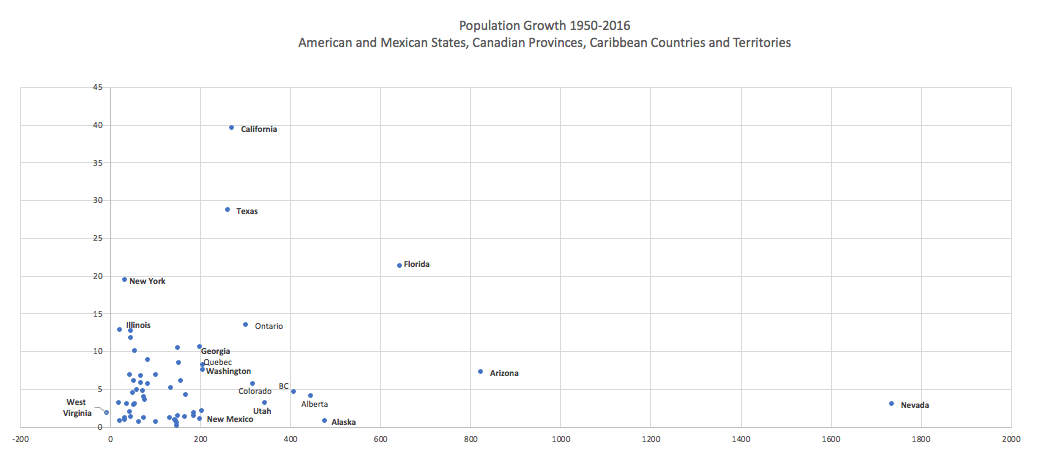
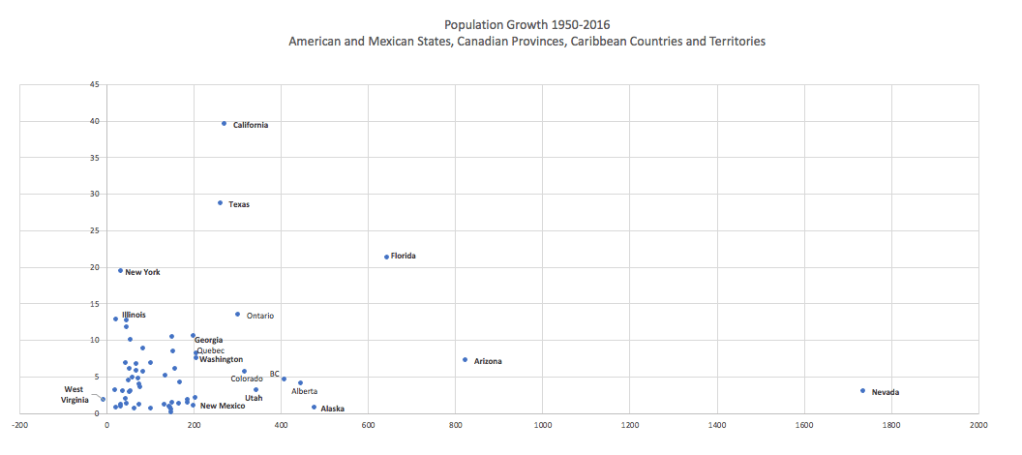
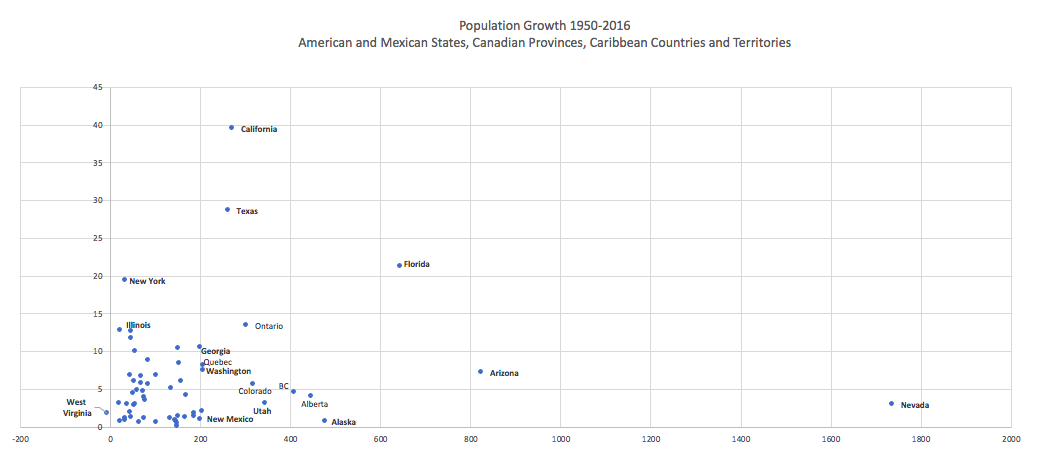
The idea for this post came from the picture above. As you can see, the fastest population growth in the United States has been in southern and western states, led by Nevada, Arizona, and Florida. Northern and central states have grown much more slowly, and West Virginia’s population even shrank a little bit. In the following charts, I’ve graphed the data above, and added in Canadian provinces, Mexican states, and Caribbean countries to provide further points of comparison.

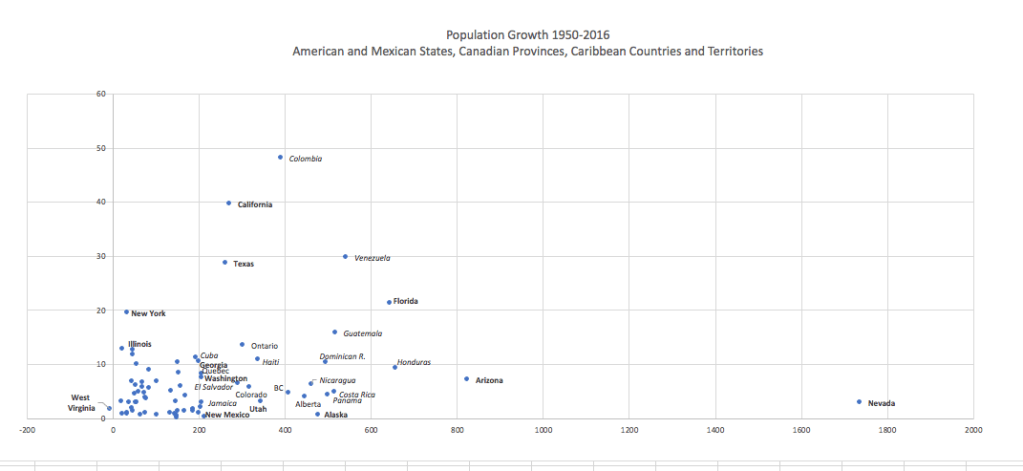
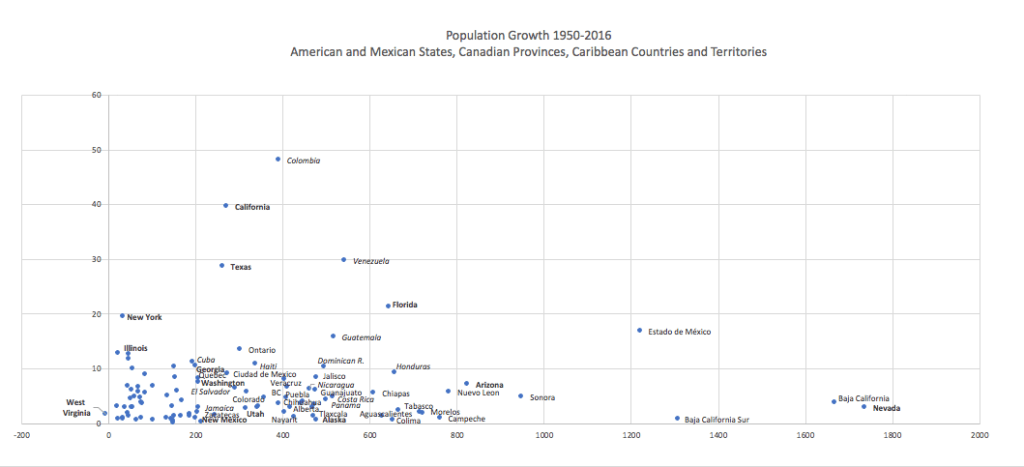
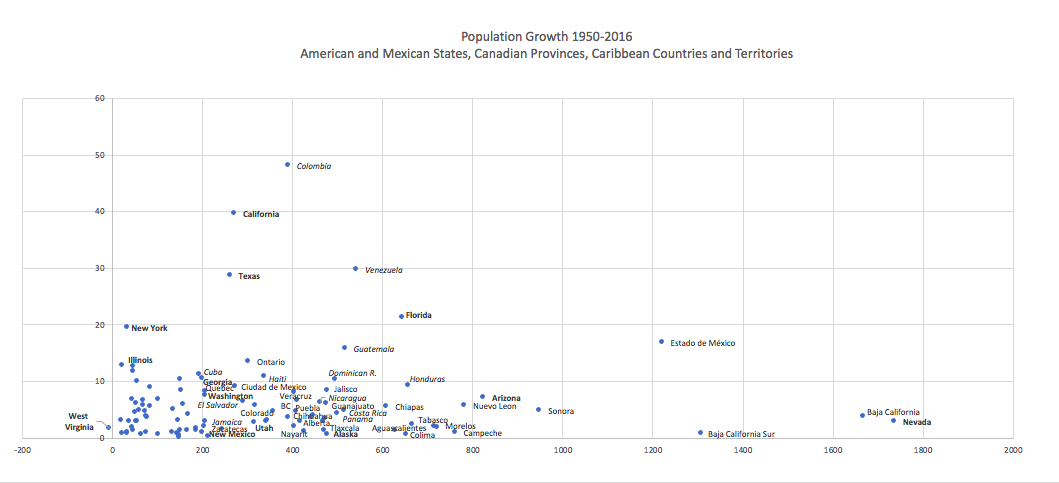
The x-axis shows population growth between 1950-2016 in percentage terms, the y-axis shows total population size as of 2016 (in millions).

This first chart shows just American states and Canadian provinces:


The big standouts in the US are California, Texas, Florida, Arizona, and Nevada. In Canada too, the southernmost province, Ontario, and the westernmost provinces, Alberta and British Columbia, grew the fastest. But, Canadians not having a proper Sunbelt to move to, even Quebec’s growth rate was faster than all but nine US states.

Now let’s add in Caribbean and Central American countries, and Puerto Rico:


The populations of these countries grew faster than most American states, though none matched the growth of Arizona or Nevada. The most notable standouts were Colombia, Venezuela, Honduras, and Guatemala; the Caribbean islands grew more slowly.

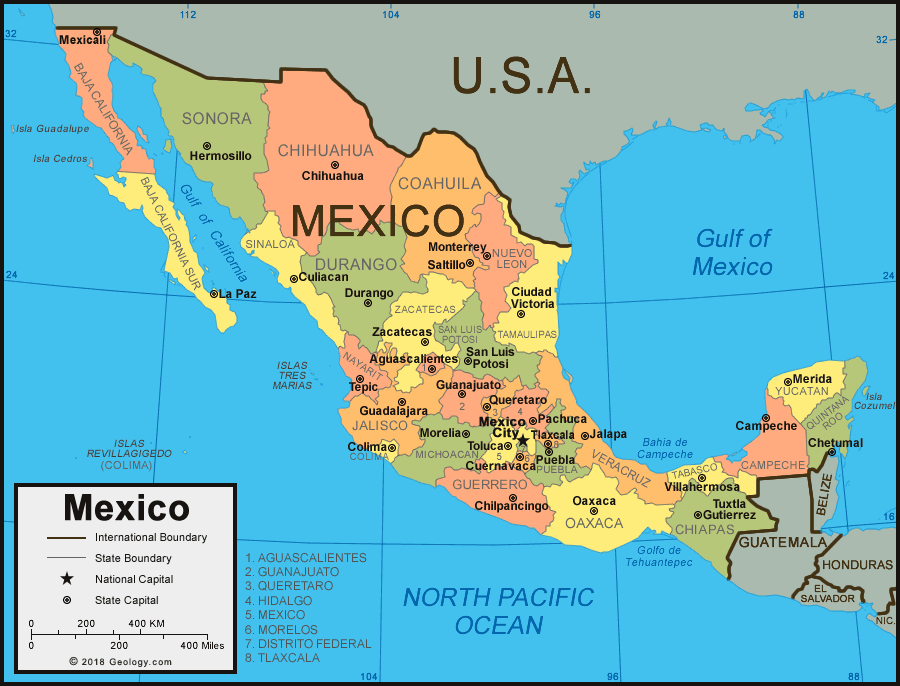
Now let’s add in the Mexican states. Mexico has 32 states, but the following chart shows only 29 of them; I could not find the relevant statistics for the states Oaxaca or Durango, and did not include the state of Quintana Roo here because its growth has been so incredibly rapid since Cancun was developed in the 1970s that to include it would have distorted the entire chart. (You can see what that looks like further below).


As with the Caribbean and Central America, Mexican states have grown faster than American ones. As in the US, the fastest-growing Mexican states have tended to be near the US-Mexico border, and near California and Arizona in particular. These include the two Baja California’s, Sonora, and Neuvo Leon.

The big standout, however, is Estado de Mexico (State of Mexico), which includes part of Mexico City. In contrast, Ciudad de Mexico, which includes the historic centre of Mexico City, had one of the slowest-growing populations. This is similar to America’s District of Columbia, the population of which has actually shrunk since its peak in 1950, even as the population of Washington’s metropolitan area in Virginia and Maryland has grown relatively quickly.

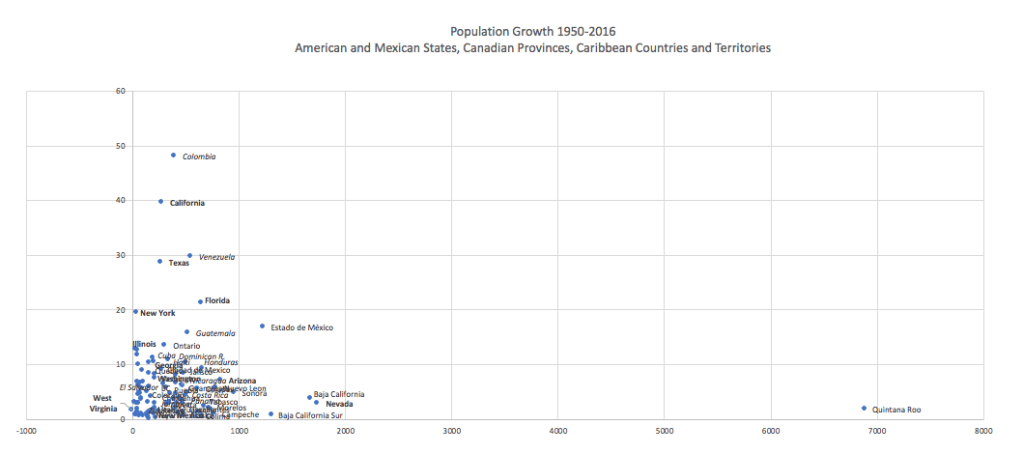
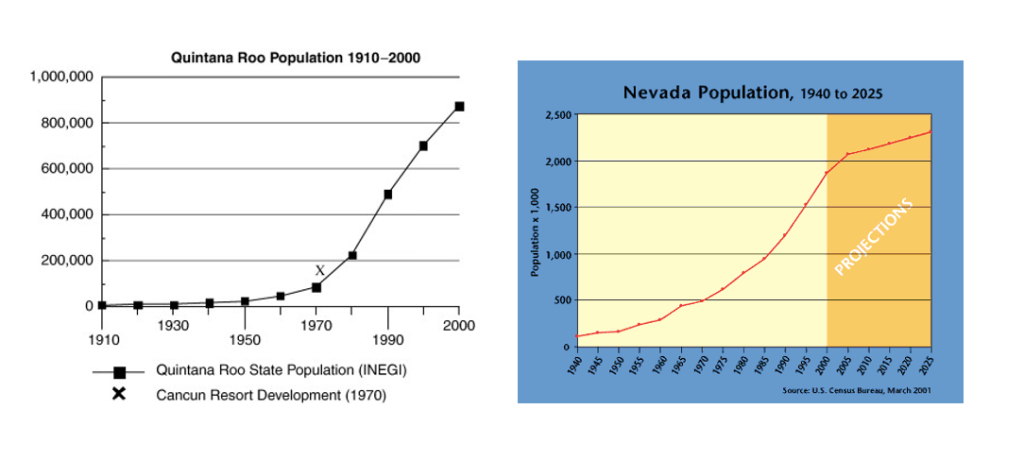
Now, let’s add in the outlier that is Quintana Roo. Its growth, based on Cancun, is similar to Nevada’s Vegas-driven growth. But whereas Nevada’s population in 2016 was around 17 times larger than it was in 1950, Quintana Roo’s was nearly 70 times larger than it was in 1950:

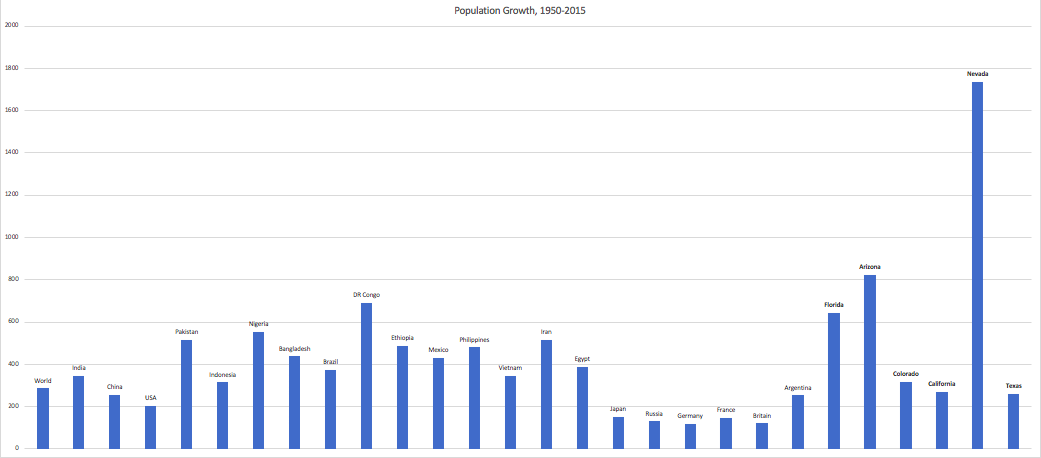
Finally, let’s compare the growth of US states to countries worldwide. Here is the population growth percentage of some of the biggest countries in the world, compared to five of the fastest-growing American states:


This may just be a coincidence but, as in the US where desert states like Arizona and Nevada have grown the fastest, so too in the world have desert countries grown the fastest:


While Nevada’s growth rate has been about the same as Kuwait’s, the comparison between sin cities Las Vegas and Dubai (in the United Arab Emirates, the biggest growth outlier in the world) might be the most apt.

Elevation and Landlockedness

Elevation above sea level and proximity to the sea coast are two important factors that influence a city’s climate, economy, and history. Here I’ve tried to plot many of the world’s cities according to these factors, to provide a comparative perspective that will hopefully be of interest.

This being my first home-baked chart, I made a few rookie mistakes. The chart may be a bit blurry (if so, you can download the following document to see a clear version). And I put elevation on the horizontal axis, though it would have been much more intuitive to have it on the vertical.

There is a lot happening in this chart, so let’s walk through it together:

  1. See that blue box in the bottom-left corner: that represents the areas where about 35-40 percent of people in the world live, close to sea level and close to the sea.

  2. The Swiss Mis-conception: Switzerland is sometimes used as a way to downplay the significance of geography. If the Swiss are so rich, what excuse do other poorer mountain countries have? Well, you can see part of the flaw with that line of thinking here: Swiss cities are neither high above, nor far from, the sea. Zurich and Geneva (and all the other Swiss cities too, though they are not shown on this chart) are at the very bottom-left, less than 500 metres above sea level and less than 500 kilometres from the nearest coast.

  3. European(/Mediterranean) exceptionalism: As with Zurich and Geneva, even the highest-elevation or furthest inland European cities are in the bottom-left of the chart, near sea level and near the sea coast. Specifically, you can see Madrid just over 500 metres above sea level, and Moscow just over 500 km from the sea coast. Similarly, in the Mediterranean regions outside of Europe, you can see Damascus about as high up as Madrid, and Khartoum a similar distance from the sea as Moscow. (Even though Khartoum is 2600+ km upriver on the Nile, it is only about 600 km across the desert to the Red Sea). Cities like Ankara (Turkey), Amman (Jordan), and Yerevan (Armenia) are near this corner of the chart too, though a few hundred metres higher above sea level than Damascus and Madrid. Most other European or Mediterranean cities would be too cramped to show: nearly all of them would be inside that little blue box. Even the highest small towns in Europe, such as Davos in Switzerland, are only around 1500 metres above sea level. That’s 100 metres lower than Denver, Colorado.

  4. The Extreme Edge: starting in the bottom-right, the big standout is El Alto-La Paz (population ~1.8 million) in Bolivia, which sits about 4000 metres above sea level. Other Andean cities, in Bolivia, Peru, Ecuador, and Colombia, are in this corner of the chart as well. Further inland, most of the cities on the outer edge of the chart are in China, on the Tibetan plateau (notably, Lhasa and Xining), or in Yunnan province in southwestern China (notably Lijiang and Kunming, but also smaller, higher ones like Shangri-La), or in northwestern China in Gansu (Gansu’s capital, Lanzhou, is next to Denver here) and especially in Xinjiang (Hotan, Kashgar, and in the top-left corner, the trio of Bole, Yining, and even a city of ~4.5 million people: Urumqi.) Also in this area of the chart are cities in Xinjiang’s fellow stans, such as Kabul (Afghanistan), Almaty (Kazakhstan), Tashkent (Uzbekistan), Skardu (Pakistan), Bishkek (Kyrgyzstan), and Osh (Tajikistan). Finally, furthest inland of all is Novosibirsk, which with a population of about 1.6 million is actually the third largest city in Russia (though still much smaller than Moscow or St Petersburg). It is followed by Oskemen in Kazakhstan (pop. ~300,000), a city near where the borders of Russia, Kazakhstan, Mongolia, and China’s Xinjiang region meet. Just behind them are a number of other cities in Russian Siberia.

  5. Siberian cities like Novosibirsk raise the question of whether or not the Arctic Sea should count for the purposes of this chart. I’ve included Novosibirsk, Oskemen, Krasnoyarsk (Russia), and Surgut (Russia) twice, once not counting the Arctic Sea – “ex-Arctic” – and once counting the Arctic Sea. As you can see, “Novosibirsk (ex-Arctic)” is over 3000 kilometres inland, whereas Novosibirsk’s distance to the Arctic Sea is only around 1600 km, putting it closer to cities like Minneapolis and Winnipeg (not counting Hudson’s Bay) on the chart. Oskemen, in contrast, is still close to 2500 km from the sea even when you do include the Arctic. That is still about 700-1000 km further than the “poles of inaccessibility” – the furthest spots inland – of Africa or the Americas. You can see some of the furthest inland cities in those continents on the chart, such as Kisangani (DR Congo), Bismarck (US), or Cuiaba (Brazil), all around 1500 km from the coast.

  6. I’ve bolded the names of certain cities, either because they are very large or because they are medium-sized cities that are very high up and/or very far from the sea. In a few cases, most notably Mexico City (followed perhaps by Addis Ababa in Ethiopia and Bogota in Colombia), a city is very large and very high up. In contrast, there are no very large cities further inland than about 1000 km, around where cities like Lahore, Chengdu, Chicago (if you don’t count Great Lakes), Kigali (if you don’t count other Great Lakes) and Kabul are situated.

  7. For the most part, I have limited “city” to places with populations of at least 100,000. This leaves out even more remote settlements; the highest of which, La Rinconada in Peru (pop. ~17,000), is another 1000 m or so higher than El Alto. There are a few exceptions, however, where I have included smaller cities, mostly around the outer edge of the chart. These include, for example, Cheyenne (pop ~64,000) the capital of Wyoming, Santa Fe (pop ~84,000) the capital of New Mexico, Timbuktu (pop ~55,000, in 2009) in Mali, or Tamanrasset (pop ~93,000, in 2008) in the Algerian Sahara. (In a future home-baked chart we’ll look at the elevation and landlockedness of extreme towns and settlements, sea cliffs, and mountain peaks).

  8. Many of the cities ranged along the y-axis are in the Americas or the former Soviet Union.
    Many are upstream on major rivers, such as Manaus (the Amazon), Minneapolis and St Louis (Mississippi), Delhi (Ganges), Lahore (Indus), Chengdu (Yangtze), Xian (Huang he, aka Yellow), Juba (White Nile), Ascuncion (the Paraguay River, upstream fron the Parana), Kisangani (Congo), Perm and Moscow (eastern and western tributaries of the Volga, respectively) and various Russian cities located on major Siberian rivers that flow north to the Arctic. Several are also next to or near great lakes, like Chicago (Lake Michigan), N’Djamena (on the formerly great Lake Chad), Winnipeg (Lake Winnipeg and its neighbours), or Irkutsk not far from the very great Lake Baikal.

  9. Most the cities ranged along the x-axis are Latin American or in regions near the Indian Ocean (the Middle East, eastern Africa, southern Asia, etc.). You can see, for example, a city like Caracas (Venezuela’s capital), roughly 900 metres high yet only about 10-20 km from the sea. Or, close to it, Sao Paolo (Brazil’s megacity), over 750 metres high yet only about 50 km from the sea. Near Sao Paolo on the chart another big city is Bangalore, in southern India, 920 meters high and about 265 km from both India’s western and eastern coasts. Nearly all these cities are in the Tropics; several, like Nairobi in Kenya and Quito in Ecuador, are next to the Equator. A number of the other capital cities around the Horn of Africa region are even higher than Nairobi is: Addis Ababa in Ethiopia, Asmara in Eritrea, and Sanaa in Yemen.

  10. Finally, there is that busy middle cluster of the chart, between about 1000-1500 metres above sea level and 500-1000 kilometres inland. This is, roughly speaking, the Persianate section of the chart, centred on Tehran but ranging widely across Iran and much of Central Asia to include cities like Isfahan, Tabriz, and Shiraz (which are higher but closer to the sea) on one side and Mashhad, Herat, and Dushanbe (which are lower but further from the sea) on the other. Along with Tehran, several other capital cities are here: Brasilia (Brazil), Kathmandu (Nepal), Lusaka (Zambia), Lilongwe (Malawi) and Kampala (Uganda). And for North America, there is Calgary and Salt Lake City.

Reading Diary

January 2026
Utopia, by Thomas More (1516)
Wolf Hall, by Hilary Mantel (2009)

December
The Ordeal of Gilbert Pinfold, by Evelyn Waugh (1957)

November
Melting Point, by Rachel Cockerell (2024)
From Citizen to Refugee, by Mahmood Mamdani (1973)

October
The Killing of Osama bin Laden, by Seymour Hersh (2016)
The Battle of the Ayatollahs in Iran, by Alex Vatanka (2021)
Gulliver’s Travels, by Jonathan Swift (1726)

September
The Master of the Day of Judgement, by Leo Perutz (1923)
Bridge of Birds, by Barry Hughart (1984)
Wife to Mr. Milton, by Robert Graves (1943)
Shielding the Flame, by Hanna Krall and Marek Edelman (1977)

August
Seven Brothers, by Alexis Kivi (1870)

July
The Crisis of Canadian Democracy, by Andrew Coyne (2025)
Rise and Kill First: The Secret History of Israel’s Targeted Assassinations, by Ronen Bergman (2018)

June
Bring Up The Bodies, by Hilary Mantel (2012)
Leonardo’s Judas, by Leo Perutz (1959)
The War and the Jews, by Vladimir Jabotinsky (1940)
Perfidy, by Ben Hecht (1961)

May
With The Turks in Palestine, by Alexander Arohnson (1916)

April
Fervor, by Toby Lloyd (2024)

March
Travel Light, by Naomi Mitchison (1952)
The 1970s: A New Global History, by Thomas Borstelmann (2011)

February
Steppenwolf, by Hermann Hesse (1927)
The Swedish Cavalier, by Leo Perutz (1936)

January 2025
Journey into the Land of the Zeks and Back, by Julius Margolin (1949)
Ivory Towers on Sand, by Martin Kramer (2001)
The Wisdom of Plagues, by Donald G. Mcneill Jr. (2024)

December
A World Apart, by Gustav Herling-Grudzinski (1951)
The City Without Jews, by Hugo Bettauer (1922)

November
Demian, by Hermann Hesse (1919)
The Perfect Wagnerite, by George Bernard Shaw (1898)

October
Vienna’s Golden Autumn, 1866-1938, by Hilde Spiel (1987)

September
Animal Liberation Now, by Peter Singer (2023)

August
The Netanyahus, by Joshua Cohen (2021)

July
Benazir Bhutto: Favoured Daughter, by Brooke Allen (2005)
The Clockwork Universe, by Edward Dolnick (2011)
Midnight’s Furies: The Deadly Legacy of India’s Partition, by Nisid Hajari (2015)

June
The Dark Forest, Liu Cixin (2008)
Wagnerism, by Alex Ross (2020)

May
Apeirogon, by Colum McCann (2020)

April
Burma Sahib, by Paul Theroux (2024)

March
A Clergyman’s Daughter, by George Orwell (1935)

February
Out of Italy, by Fernand Braudel (1974)

January 2024
Moby-Dick, by Herman Melville (1851)

December
Bat Bomb, by Jack Couffer (1992)
One Day in the Life of Ivan Denisovich, by Aleksandr Solzhenitsyn (1962)
Keep the Aspidistra Flying, by George Orwell (1936)

November
Narrative Economics, by Robert Shiller (2019)
Bicycles in War, by Martin Caidin (1974)

October
The Bomber Mafia, by Malcolm Gladwell (2021)

September
War with the Newts, by Karel Capek (1936)
The Löwensköld Ring, by Selma Lagerlöf (1925)
Tolkien and the Great War, by John Garth (2003)

August
The Forty Days of Musa Dagh, by Franz Werfel (1933)
Coming Up For Air, by George Orwell (1939)

July
Abdul Aziz Al-Saud and the great game in Arabia, 1896-1946, by Hassan Syed Abedin (2002)
The Skies Belong to Us: Love and Terror in the Golden Age of Hijacking, by Brendan I. Koerner (2013)

June
Ties, by Dimenico Starnone (2014)
On Saudi Arabia, by Karen Elliot House (2012)

May
The Last Man in Europe, by Dennis Glover (2017)
Claudius the God and His Wife Messalina, by Robert Graves (1934)
The End of the End of the Earth, essays by Jonathan Franzen (2018)

April
Free of Fear, by Hussain al-Shahristani (2021)
Haifa Republic: A Democratic Future for Israel by Omri Boehm (2021)
No Place To Go: How Public Toilets Fail our Private Needs, by Lezlie Lowe (2018)

March
Hard Times, by Charles Dickens (1854)
Numbers Don’t Lie, by Vaclav Smil (2020)
Armageddon Averted: The Soviet Collapse, 1970-2000, by Stephen Kotkin (2001)

February
Floating to Space: The Airship to Orbit Program, by John M. Powell (2008)

January 2023
Big Sister Little Sister Red Sister: Three Women at the Heart of Twentieth Century China, by Jung Chang (2019)

December
The Naked Olympics: the True Story of the Ancient Games, by Tony Perrottet (2004)

November
The Han: China’s Diverse Majority, by Agnieszka Joniak-Luthi (2015)
Summer Will Show, by Sylvia Townsend Warner (1936)

October
Geography is Destiny: Britain and the World, a 10,000 Year History, by Ian Morris (2022)

September
The Great Divorce, by C.S. Lewis (1946)
Right of Way: Race, Class, and the Silent Epidemic of Pedestrian Deaths in America, by Angie Schmitt (2020)

August
That Hideous Strength, by C.S. Lewis (1945)
The Great Railway Revolution: The History of Trains in America, by Christian Wolmar (2012)

July
Homeland Elegies, by Ayad Akhtar (2020)
J.R.R. Tolkien: Author of the Century, by Tom Shippey (2000)
To the Edge of the World: The Story of the Trans-Siberian Railroad, by Christian Wolmar (2013)

June
Kingdom of Characters, by Jing Tsu (2022)
Distant Lands, by Halford Mackinder (1912)
Creating the 20th Century, by Vaclav Smil (2004)
Gentlemen of the Road, by Michael Chabon (2007)

May
Helena, by Evelyn Waugh (1950)
The Nineties, by Chuck Klosterman (2022)
The Splendid and the Vile, by Erik Larson (2020)
The Feast of the Goat, by Mario Vargas Llosa (2000)
Mr. Fortune’s Maggot, by Sylvia Townsend Warner (1932)

April
The Three-Body Problem, by Liu Cixin (2006)
The Premonition, by Michael Lewis (2021)

March
The Every, by Dave Eggers (2021)

February
Heart of Darkness, by Joseph Conrad (1899)

January 2022
The Road to Middle-Earth, by Tom Shippey (1982)

December
The Cat’s Cradle Book, by Sylvia Townsend Warner (1940)

November
Orwell and Politics, collected writings by George Orwell (2001)

October
Earth, by Emile Zola (1887)
Koba the Dread, by Martin Amis (2002)

September
Kingdoms of Elfin, by Sylvia Townsend Warner (1977)
Love Among the Ruins: A Romance of the Near Future, by Evelyn Waugh (1953)

August
Men at Arms, by Evelyn Waugh (1952)
Lud-in-the-Mist, by Hope Mirlees (1926)
The Lanchaster Tradition, by GF Bradby (1913)

July
The Late Mattia Pascal, by Luigi Pirandello (1904)
Childhood’s End, by Arthur C. Clarke (1953)
War of Shadows, by Gershom Gorenberg (2021)

June
Hav, by Jan Morris (1985)

May
Jigsaw: An Unsentimental Education, by Sybille Bedford (1989)

April
Of Smiling Peace, by Stefan Heym (1944)

March
Hitler, My Neighbour, by Edgar Feuchtwanger (2013)

February
The Iron Road: The Illustrated History of Railways, by Christian Wolmar (2014)

January 2021
The Corner That Held Them, by Sylvia Townsend Warner (1948)