Iran (Oct 2025, a long report)
Iran – 10 Charts (Jan 2026)
Notes on Iran (March 2026)
Hey, sorry to redirect you away from this website, but you can read my latest article on Iran on Substack: https://josephshupac.substack.com/p/notes-on-iran
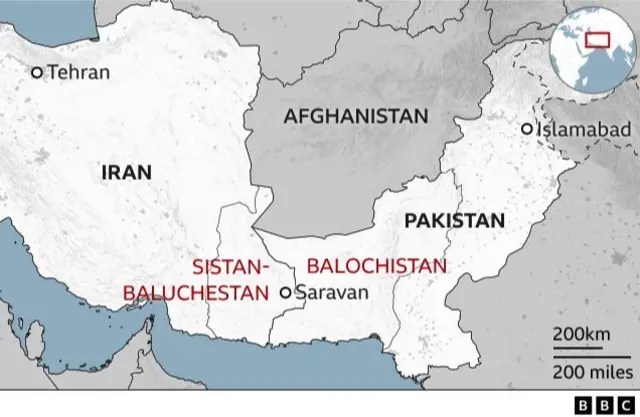
Balochis, the primarily Sunni inhabitants of the mountainous region spanning the borders between Pakistan, Iran, and Afghanistan, have been involved in significant attacks of late. According to Chatham House, in Pakistan, in March 2025, “Baloch separatists hijacked a passenger train carrying more than 400 people travelling from Quetta to Peshawar…Responsibility for the attack was claimed by the militant Baloch Liberation Army (BLA). The subsequent siege, near the Bolan Pass in a remote part of Pakistan’s southwestern province of Balochistan ended – apparently without mass casualties – after a 36-hour stand-off between the hijackers and army special forces. But some lives were lost. According to Pakistani military sources, at least 31 people, including civilians and security personnel, as well as 33 militants, were killed in the action. However, the BLA has disputed these figures claiming that it took 214 hostages and killed them all.”
In southeast Iran, when a Balochi suicide bombing in 2019 killed at least 27 soliders, Khamenei and other leaders publicly blamed the US, Israel, Saudi Arabia, and the UAE as being behind the attack. In 2018 , according to Wikipedia, “eleven Iranian border Guards were kidnapped by the group, with only five of them later released”. Insurgencies in this region go back decades, and include the cross-border smuggling of diesel fuel from Iran and opium from Afghanistan.
On the Pakistani side of the border, attacks by Baloch militants and suicide bombers, have often targeted Chinese nationals. According to the Australia Broadcasting Corporation, “Nearly 100 Chinese nationals have been killed in Pakistan in recent years amid local discontent over the failure of China-backed infrastructure projects”. Attacks have also targeted Shia, who are an estimated 10-15% of the population in both Pakistan and Afghanistan.
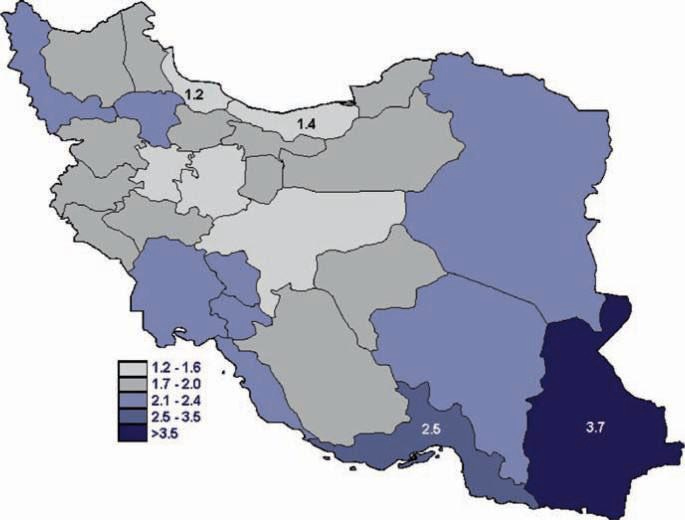
Iran, fertility rate by province. In Sistan-Baluchistan in the southeast (population 3-4 million),fertility rates are closer to those in Pakistan and Afghanistan than to the rest of Iran. An estimated 15 million Balochis live across Iran, Pakistan, and Afghanistan, with most living in Pakistan and perhaps one-third living in Iran
“In 2024, Iran carried out a series of missile and drone strikes within Pakistan’s Balochistan province, claiming that it had targeted the Iranian Baloch Sunni militant group Jaysh al-Adl. The incident occurred one day after Iran carried out a similar series of aerial and drone strikes within Iraq and Syria, claiming that it had targeted the regional headquarters of the Israeli intelligence agency Mossad within Iraqi semi-autonomous Kurdish region and several strongholds of terrorist groups, in Taltita, Syria, in response to the Kerman bombings on 3 January, for which the Islamic State took responsibility and December 2023 killing of IRGC general Seyed Razi Mousavi.”
It is not clear whether or not Hersh’s statements about a US relationship with Balochi groups in Iran are actually true.
But Balochi attacks were common during this period. According to a US state department report:
“In March 2006, Jundallah attacked a motorcade in eastern Iran, which included the deputy head of the Iranian Red Crescent Security Department, who was taken hostage. More than 20 people were killed in the attack. The governor of Zahedan, his deputy, and five other officials were wounded, and seven others were kidnapped in the attack. In May 2006, Jundallah barricaded a road in Kerman province and killed 11 civilians and burned four vehicles. The assailants then killed another civilian and wounded a child by firing at a passing vehicle. In 2007, Jundallah killed 18 border guards on the Iranian-Afghan border. Jundallah seized 16 Iranian police officers near the border with Pakistan in 2008. When the Iranian government refused to release 200 Jundallah prisoners in exchange for the hostages, Jundallah killed them. In May 2009, Jundallah attacked the crowded Shiite Amir al-Mo’menin mosque in Zahedan, destroying the mosque and killing and wounding numerous worshipers. An October 2009 suicide bomb attack in a marketplace in the city of Pishin in the Sistan va Balochistan province, which killed more than 40 people, was reportedly the deadliest terrorist attack in Iran since the 1980s. In a statement on its website, Jundallah claimed responsibility for the December 15, 2010 suicide bomb attack inside the Iman Hussein Mosque in Chabahar, which killed an estimated 35 to 40 civilians with 60-100 wounded. In July 2010, Jundallah attacked the Grand Mosque in Zahedan, killing approximately 30 and injuring an estimated 300”.
Around the same time, there were reports claiming that Mossad agents posed as American intelligence in order to work with Baloch groups in Pakistan.
Others believed Shia revolutionaries in Iran were behind the siege [of the Grand Mosque of Mecca, in 1979]. This may have led to an uprising in the Eastern Province of Saudi Arabia, where the country’s Shia minority population lives and most Saudi oil is located. People there had been attempting to celebrate Ashura on November 25, the major holiday for Shia that had been mostly prohibited in Saudi Arabia. A week later, during that same Ashura, Iran held a referendum to ratify the constitution of its new Islamic Republic, which Khomeini had declared following his success in an earlier referendum held in March
1979 was also the year in which Israel first attempted to prevent a rival country, Iraq, from developing nuclear power. In April, in southern France, Israeli agents used explosives to sabotage a reactor that was about to be shipped to Iraq. A little over a year later, in Paris, they assassinated an Egyptian scientist who was leading Iraq’s nuclear programme…Finally, Israel attacked the Iraqi reactor directly in 1981.
Iran too carried out a significant assassination in Paris in December 1979, killing Shahriar Shafiq, a son of the Shah’s twin sister. Shafiq had been the highest-ranking royal in the Iran military, and the last to leave Iran during the revolution. In Paris in 1980, the Iranians also attempted to kill Shapour Bakhtiar, the last pre-revolutionary prime minister of Iran. He had been an opponent both of the Shah’s regime and of Khomeini. That attempt was a failure, but they later did assassinate him in Paris in 1991.
…Less than a year after the Shia-inhabited oil-rich Eastern Province uprising in Saudi Arabia, a kind of mirror-image event occurred in Iran’s Arab-inhabited oil-rich Khuzestan province, during the Iranian revolution.
According to Kyle Orton, “the aftermath of the 2018 Ahvaz attack was quite similar to what happened after the Shah Cheragh attack in 2022, in terms of the doubt that the Islamic State was really responsible, and the waters were muddied further when the separatist Arab Struggle Movement for the Liberation of Ahwaz initially took responsibility, only to repudiate the claim soon after…The only other Islamic State attack there has been in Iran was on 7 June 2017, when two Islamic State suicide bombers blew themselves up at the mausoleum of Ayatollah Ruhollah Khomeini [in Tehran], and gunmen shot up the nearby Majles (parliament). The twin attacks killed at least twelve people and wounded forty-two.” (Those 2017 terror attacks occurred a day after the beginning of the crisis between the Saudis and Qataris–the latter backed by Turkey and Iran–and two days before the destruction of the Great Mosque of al-Nuri, where, among other things, the Islamic State declared their caliphate in 2014, during Iraq’s Battle of Mosul).
According to the Washington Institute, this may have contributed to the failed 2011 plot to assassinate the Saudi ambassador at a restaurant in Washington and then bomb both the Saudi and Israeli embassies: “The deployment of Bahraini Defense Force tanks, backed by Saudi Arabian and UAE forces, caused shock and anger among Bahraini Shi`a and among the Shi`a leadership and people of Iran and of Iraq. There is some indication that the Iranian leaders regretted not being in a position to support the Bahraini Shi`a in what might have been a decisive political action against the Sunni monarchy. It was reportedly right after the 2011 protests that Arbabsiar [one of the two Iranian nationals charged in the plot] presented himself to his cousin, a senior Quds Force official, and that the Quds Force began planning the assassination of the Saudi ambassador, Adel al-Jubeir. Gholam Shakuri, the IRGC-Quds Force officer identified by one of the plotters as being in charge of the operation, is believed by Saudi intelligence to have met with a radical Bahraini Shi`a cleric in Beirut in early 2011 before the operation began.”
Tensions with Saudi Arabia continued, even after the emergence of ISIS and its conquest of Mosul in Iraq in June 2014, and after the Iran nuclear deal pushed by Obama was signed in 2015:
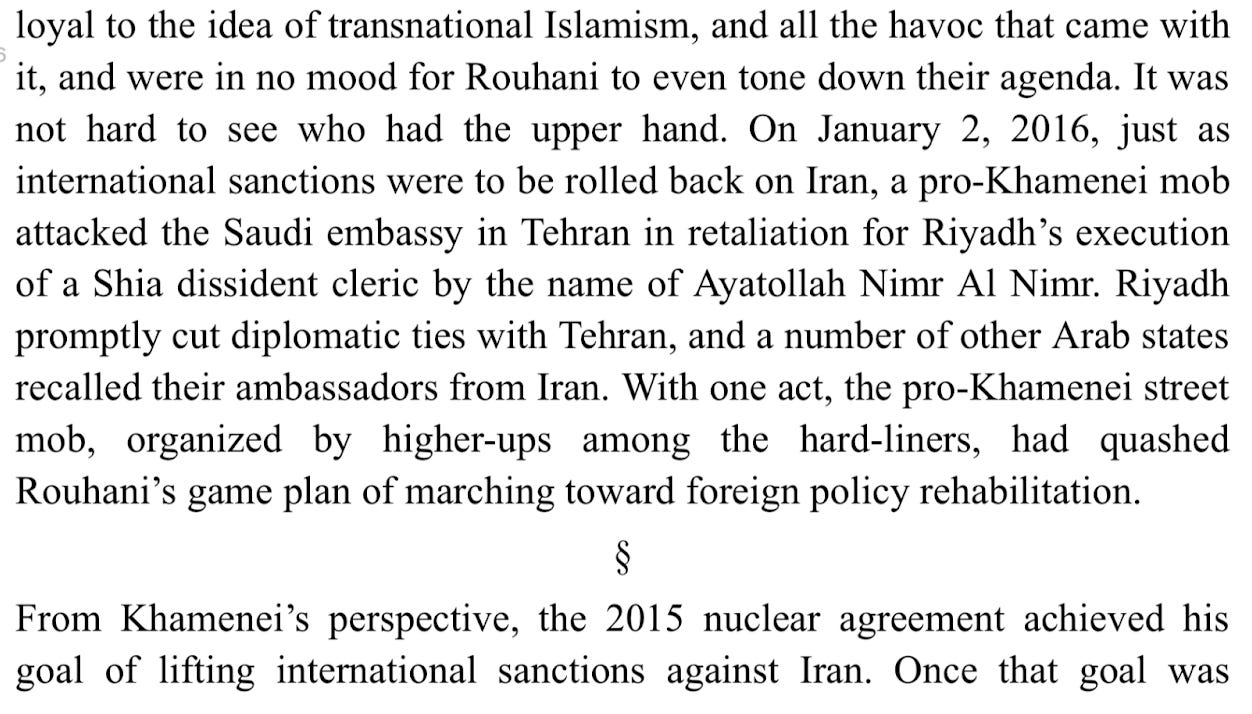
In 2017, according to this same book, “the Saudis financed the birth of Iran International, a first-class television channel with a multi-billion dollar budget, headquartered in London and operated by Iranian exiles”.
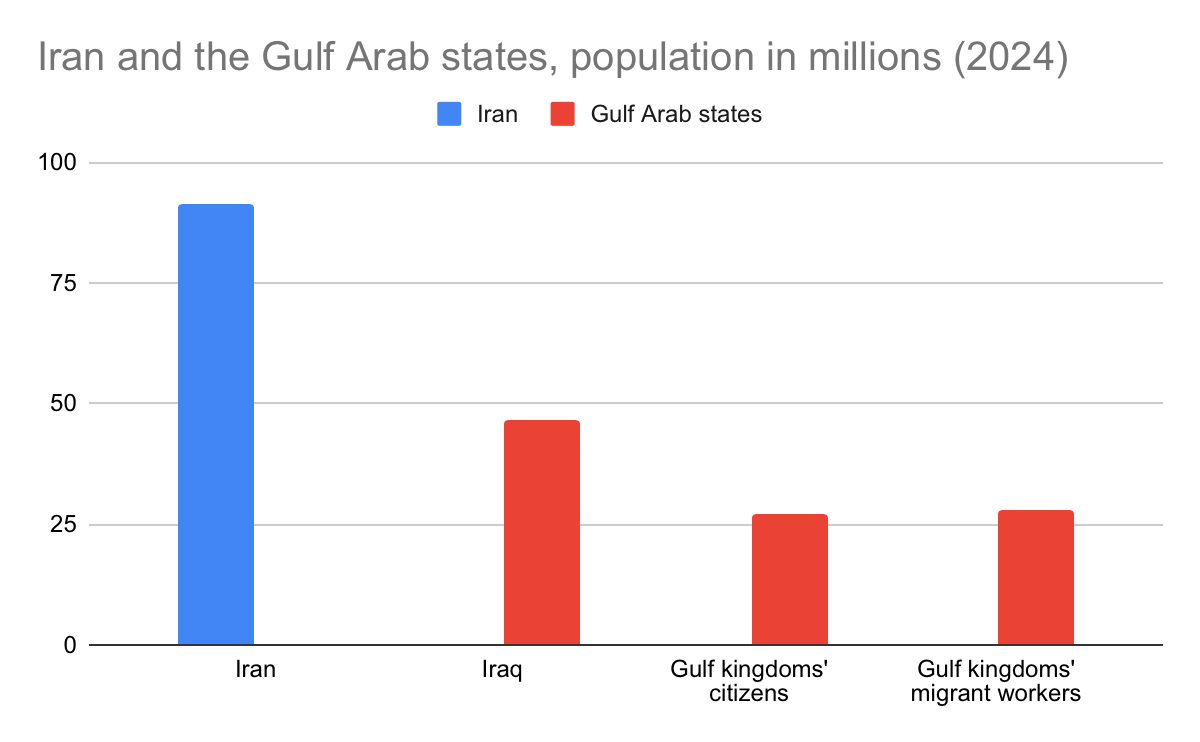
The eight Gulf countries: Iran, Iraq, Saudi Arabia, Oman, United Arab Emirates, Kuwait, Qatar, and Bahrain. In Saudi Arabia and Oman, non-citizen residents are about 40% of the population, compared to an average of more than 70% across the other four kingdoms
Table of contents
Less than two years after 9-11, the US occupied Baghdad and disbanded Saddam Hussein’s Sunni-led Ba’ath party. This empowered Iraq’s Shia Arab majority and Kurdish minority groups, swinging the Gulf region’s balance of power towards Shia Iran.
Now, less than two years after the Oct. 7th attacks, this balance has been swung back, away from Iran. But it has not been swung back just to Sunni Arab governments. Iran’s allies in Syria have been overthrown and Lebanon’s Shia Hezbollah badly weakened, but Iraq, where the majority of Gulf Arabs live, is still mostly Shia-led, as it has been since 2003. Iraq remains internally fractious, but it is also producing more oil now than at any prior time in its history.
Turkey, meanwhile, is seeing two of its historical rivals, Russia and Iran, weakened in wars. This has allowed it to spread its influence and military activity into countries like Syria and Iraq. Presumably, Turkey might become Israel or the Saudis’ next great concern.
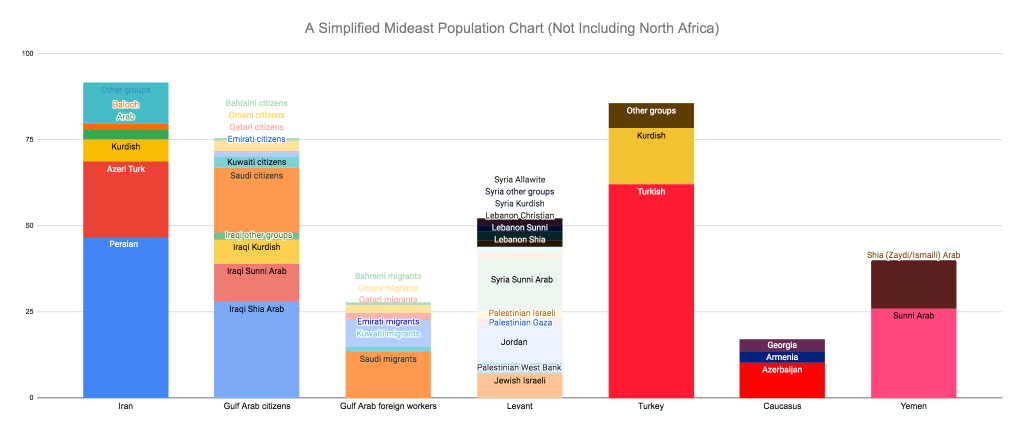
This chart should be taken with a large grain of salt, for a number of reasons. First, because the available statistics for sub-national groups often range widely and may be inaccurate. Estimates for Iraq’s Shia population range from 50-70% of Iraq’s total population, and it’s not certain that even this range is correct. Second, because there aren’t always sharp dividing lines between groups. In Iran, for example, the large Azeri Turkic minority is well-integrated into the Persian mainstream, and intermarriage between the two groups is common. (Supreme Leader Khamenei has mixed Azeri-Persian parentage). The significance of the region’s Sunni-Shia divide, similarly, although very real, is often overstated. Third, there are often important differences existing within groups. For example, Iraqi Kurds are usually listed as a single group, but they speak at least two main Kurdish languages that are not generally thought to be mutually intelligible with one another.*
To partially sum up the charts above: within the eight Gulf countries, Arabs are a plurality of the total population, but they do not greatly outnumber Persians, and they are divided somewhat equally between Iraq and the Gulf kingdoms, and between Shia Arabs (mainly in Iraq) and Sunnis (in Iraq as well as the Gulf kingdoms). Both the Azeris and Kurds are large minorities in and around the Gulf countries. Azeris in Iran for instance likely outnumber Arab citizens in Saudi Arabia. In national terms, Iran has a plurality of the Gulf countries’ population and a majority of its citizens. Iran also has a large majority of the Gulf’s Shia population:
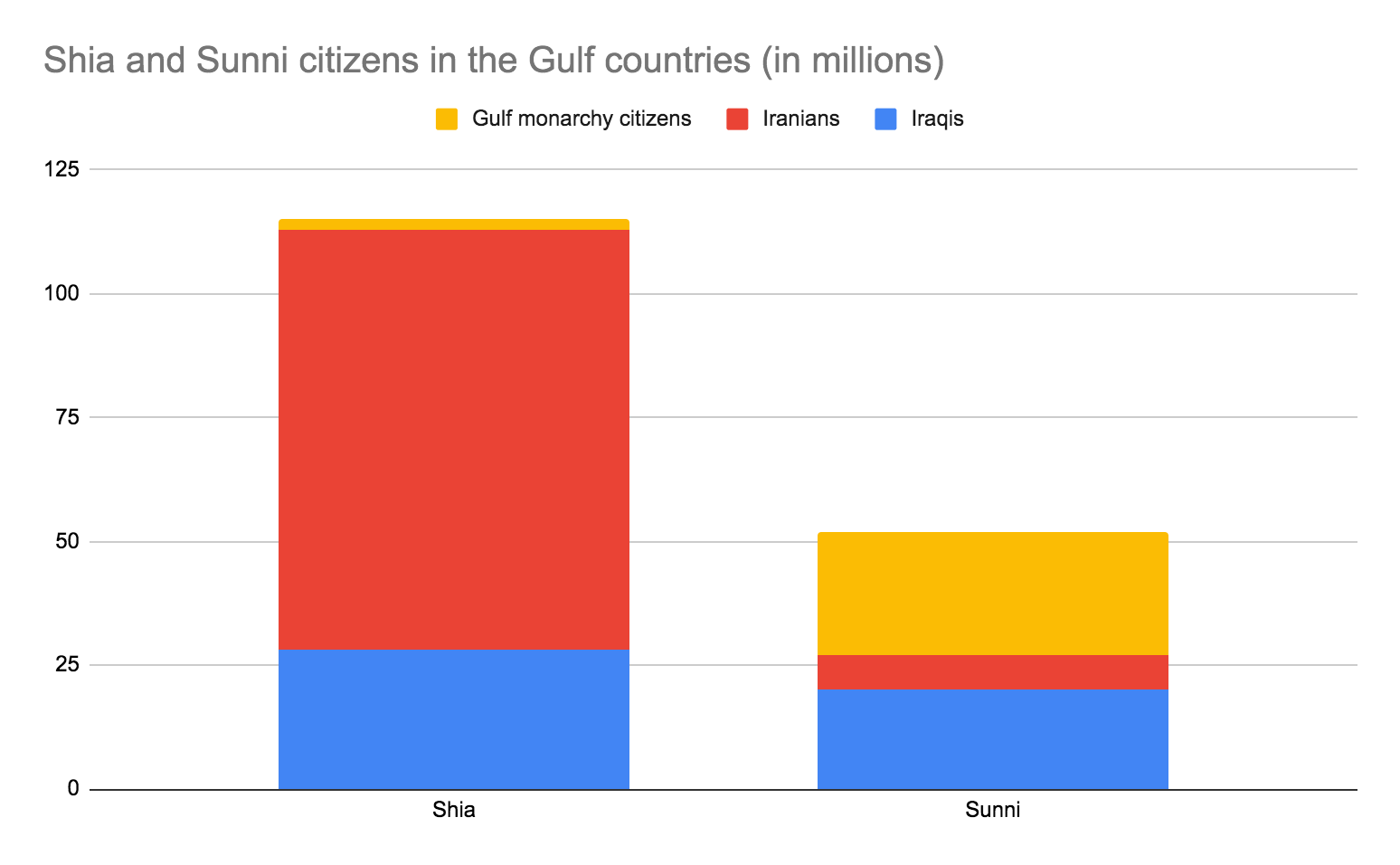
Shia Muslims outnumber Sunnis more than 2-to-1 within the Gulf region (not including the Gulf Arab monarchies’ foreign resident population, though many migrant workers in those countries are Sunni), but in the Middle East as a whole the reverse may be true. Shia are only an estimated 10-13% of the world’s Muslims. Only Iran, Iraq, Pakistan, and India are home to 10+ million Shia; only Iran, Iraq, Azerbaijan, Lebanon, and Bahrain have majority or plurality Shia populations. Iran, which only started becoming Shia on a large scale in the 1500s, is home to between ½ and ⅓ of all Shia. In Saudi Arabia, the oil-rich Eastern Province bordering the Gulf had a Shia majority until fairly recently.
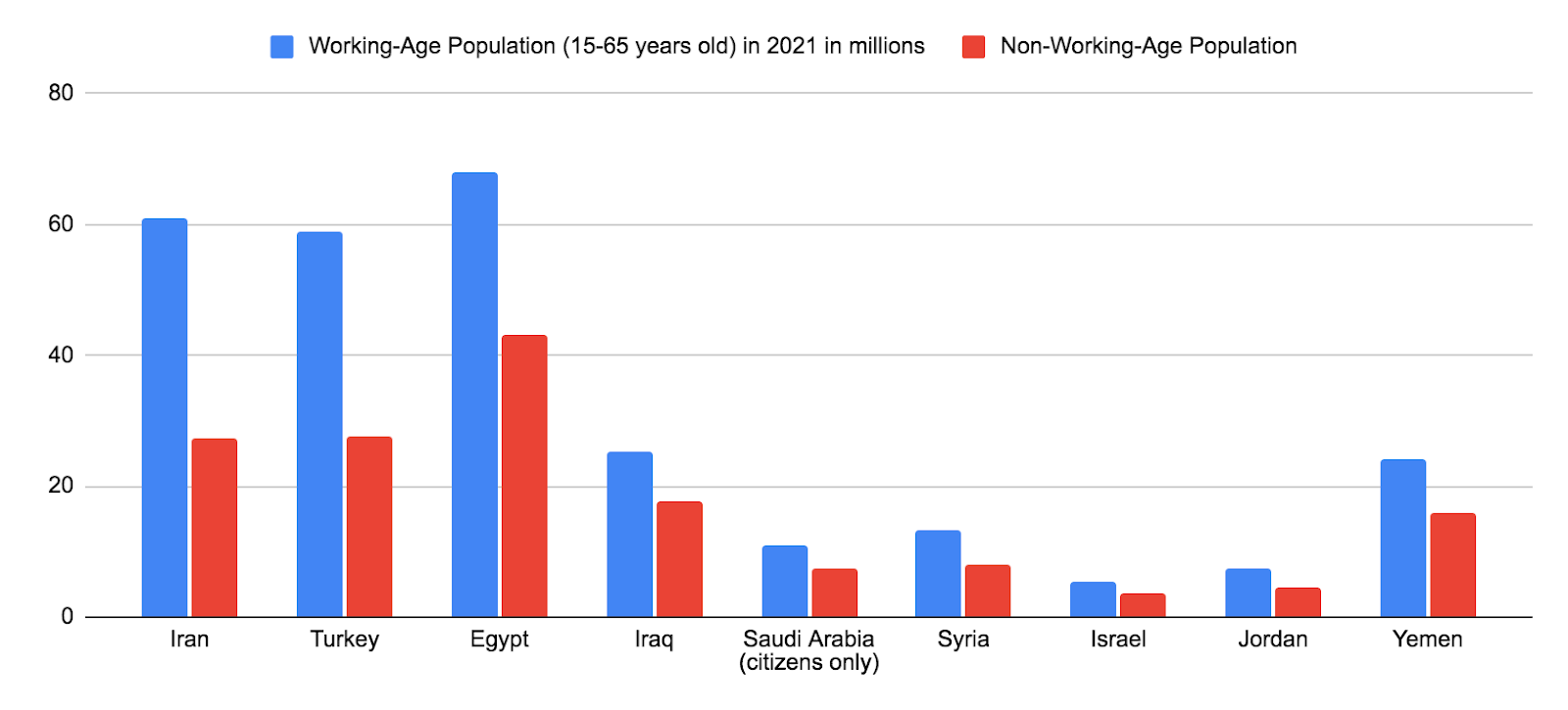
Iran and Turkey have more mature populations than countries like Egypt or Iraq, where large segments of the population are children. An estimated 69.8% of Iran’s population is between 15-65 years old. That is the highest in the world among major countries: the 22 countries that rank ahead of Iran in this regard have a combined population that is smaller than Iran’s own. Iran has the 16th largest working-age population in the world, but because it has extremely low female employment, it has only the 24th largest workforce.
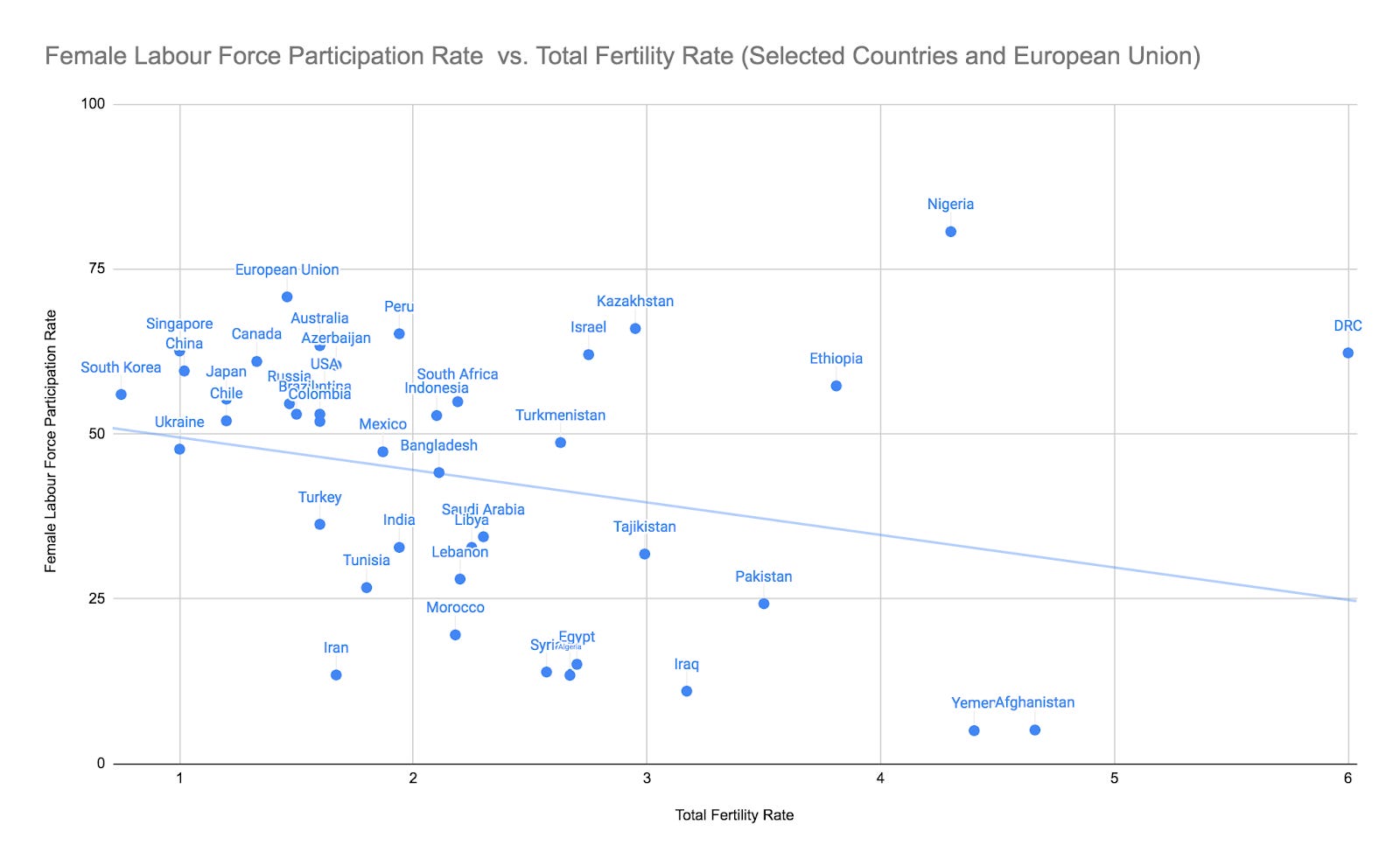
In most countries, fertility rates and female labour force participation are negatively correlated. In Afghanistan for example women tend to have lots of children but do not usually participate in the labour force, whereas in the European Union most women are in the labour force but do not have many children. There are two main exceptions to this pattern: the Islamic Republic of Iran, where women neither participate in the labour force (at least, not officially) nor have many children, and certain countries in Sub-Saharan Africa, where most women participate in the labour force and yet still have large numbers of children. (In Israel, Ultra-Orthodox Jewish women also have high labour force participation and large numbers of children). This might suggest that Iran could experience a rapid increase in its female labour force participation.
Currently, with fewer than one-sixth of Iran’s working-age women in the labour force (13% according to the World Bank), Iran’s female labour force participation rate is higher only than those of countries like Afghanistan, Yemen, and Iraq. It is far behind Saudi Arabia*, Pakistan, or Turkey, where rates are around 35%.
*In Saudi Arabia, although female participation has risen from an estimated 20% in 2015 to 35% today, working-age men outnumber working-age women by about 1.8-to-1, due to the country’s millions of foreign workers, most of whom are male. So in spite of Saudi Arabia’s newly much higher female labour force participation rate relative to Iran’s, its total workforce remains not so much less male-skewed than Iran’s.
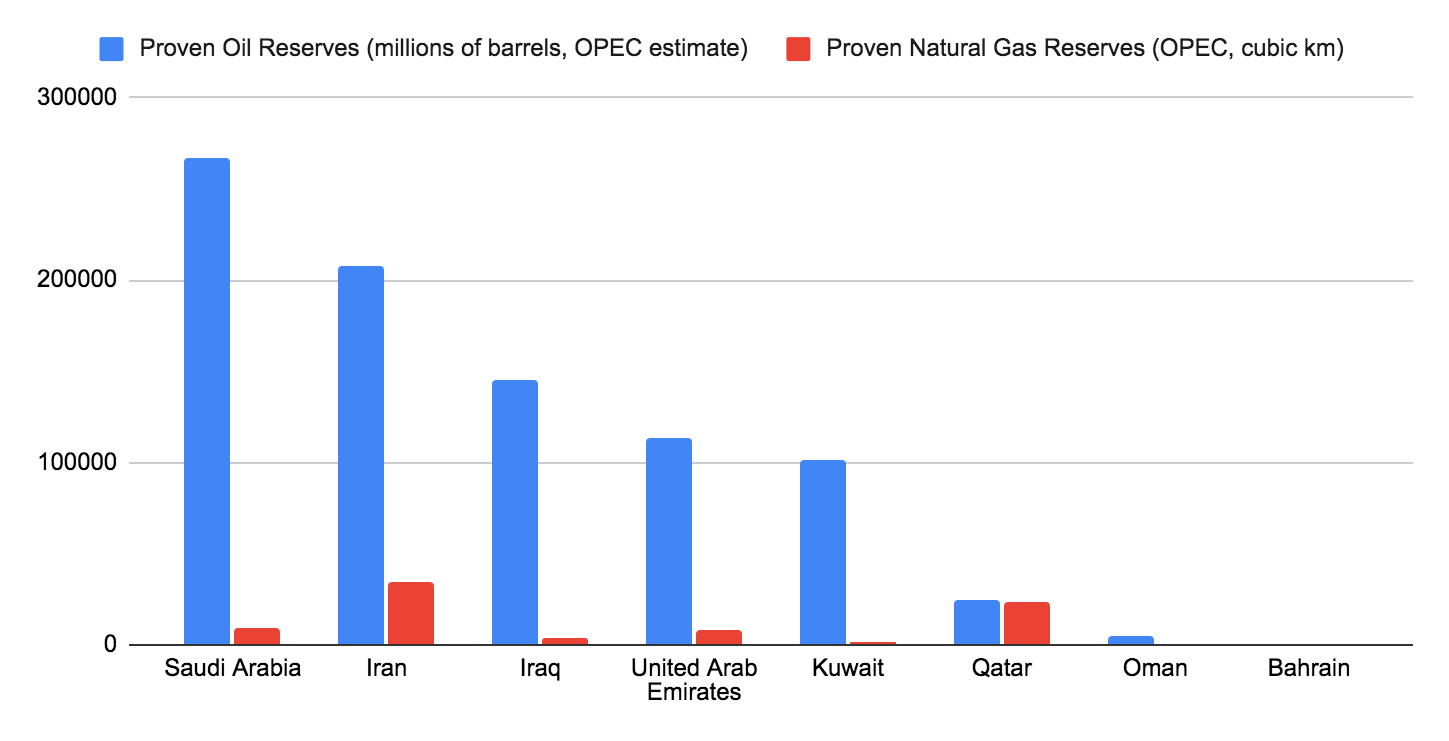
This chart shows estimated reserves, not current production. In terms of current production, Saudi Arabia produces more than 2.5 times as much oil as Iran. Iran, Iraq, and the UAE all produce roughly the same amount of oil as one another. Iran produces more than twice as much natural gas as Saudi Arabia, but both are dwarfed by the gas production of the US and Russia. Qatar is the second largest gas producer in the Gulf. Other Arab states, even Algeria and Libya, produce far less energy than those in the Gulf. Only Bahrain and Oman are not major energy producers (though even then, they are per capita).
2.
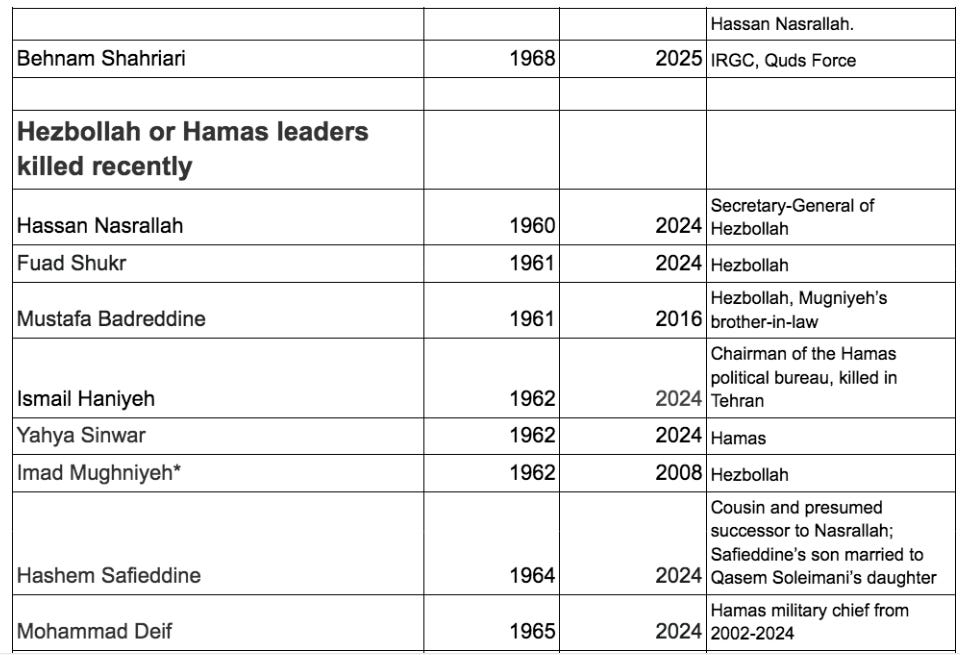
Nearly all of the leaders in Iran who were targeted and killed by Israel during its recent 12-day-war were born in the early 1960s. Partly this is because they were in their early sixties when they were killed, and had therefore reached the age where they were in charge of the country’s military and intelligence organizations*. But it is also because Iranians born in the early 1960s first reached military age when the Iran-Iraq War began in 1980, and rose through the ranks during those eight years of fighting. This was the case for a large majority of the recently killed Iranian leaders listed in the chart below.
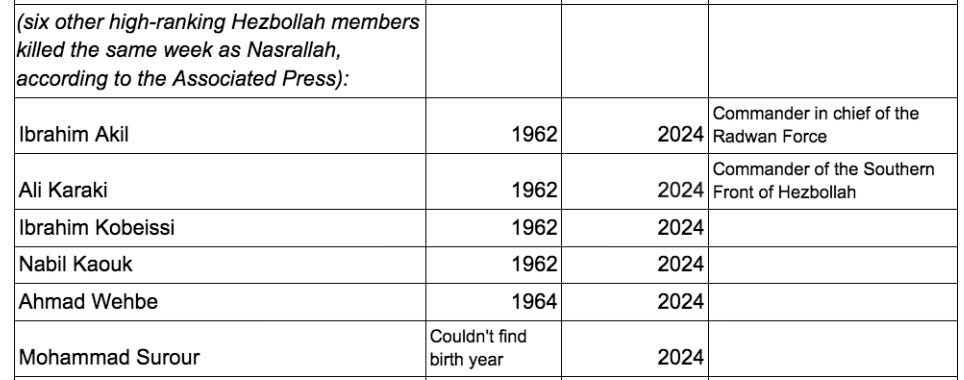
A similar dynamic likely existed within Hezbollah, which was influenced by the Iranian Revolution and was officially founded in 1982, the year of the second Israeli invasion of Lebanon during the Lebanese Civil War (1975-1990):
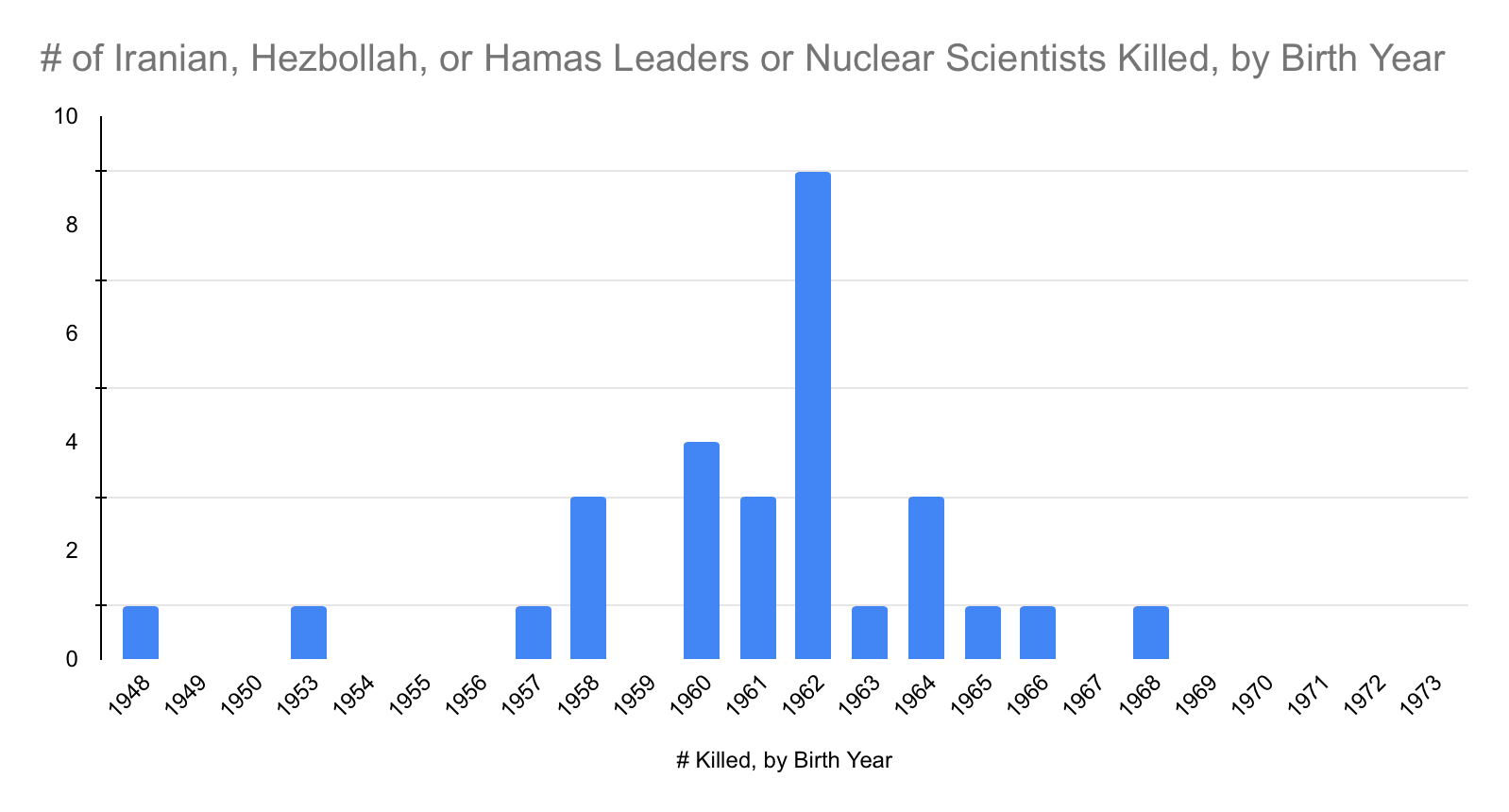
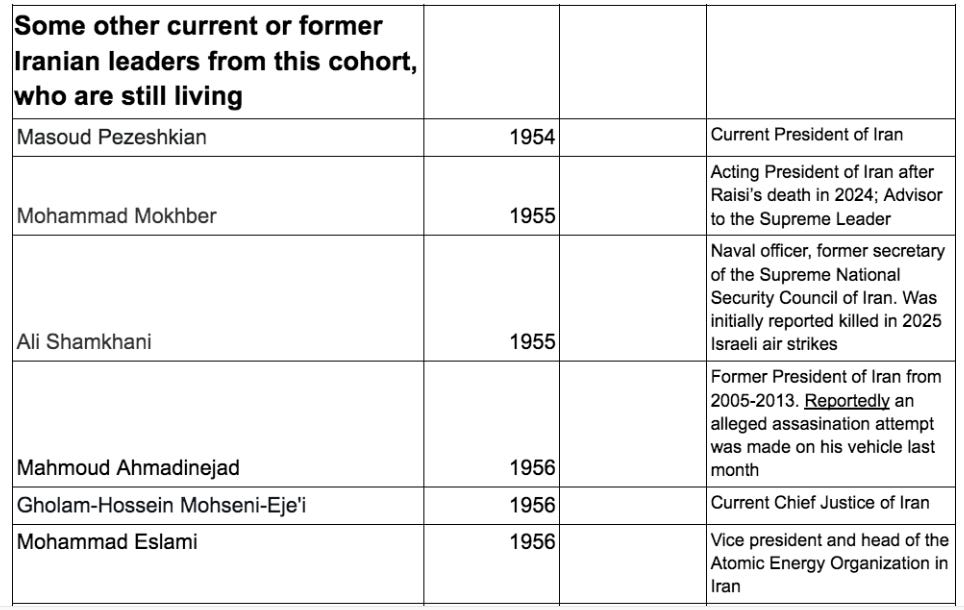
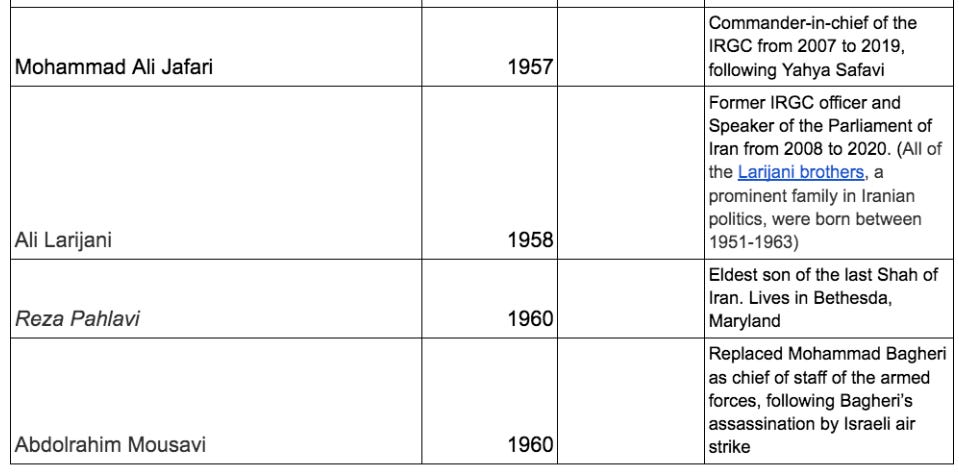
This chart includes seventeen Iranians (all killed since 2024, except for Qasem Soleimani, who the US assassinated in 2020), ten Hezbollah leaders, and three Hamas leaders (Yahya Sinwar, Mohammad Deif, and Ismail Haniyeh). There are an additional 20 Iranians listed below whose birth years I could not find. Of the 30 on this chart whose birth years were available, more than half were born in 1960, 1961, or 1962, and more than three-quarters were born between 1958-1964. These are only the prominent targeted figures in Iran I was able to find from news reports (and I included all the names I could find, regardless of their birth year). There might be many more that I missed, which could either negate or further emphasize this pattern. Iran claims there were approximately 1000 deaths of Iranians from Israeli strikes; Lebanon claims approximately 4000 deaths of civilians or Hezbollah members since Oct. 7th, 2023.
Even the youngest leaders on this list came of age during the Iran-Iraq War. Abbas Nilforoushan, for example, an Iranian officer who died in Lebanon in 2024 in the same Israeli airstrike that killed Hezbollah leader Hassan Nasrallah, was born in 1966, making him the second youngest listed below. Yet he still joined Iran’s paramilitary Basij at 14 years oldwhen the Iran-Iraq war began, and was an officer by its end. Similarly, Khamenei’s eldest sons, born in 1965 and 1969, both served in the war.
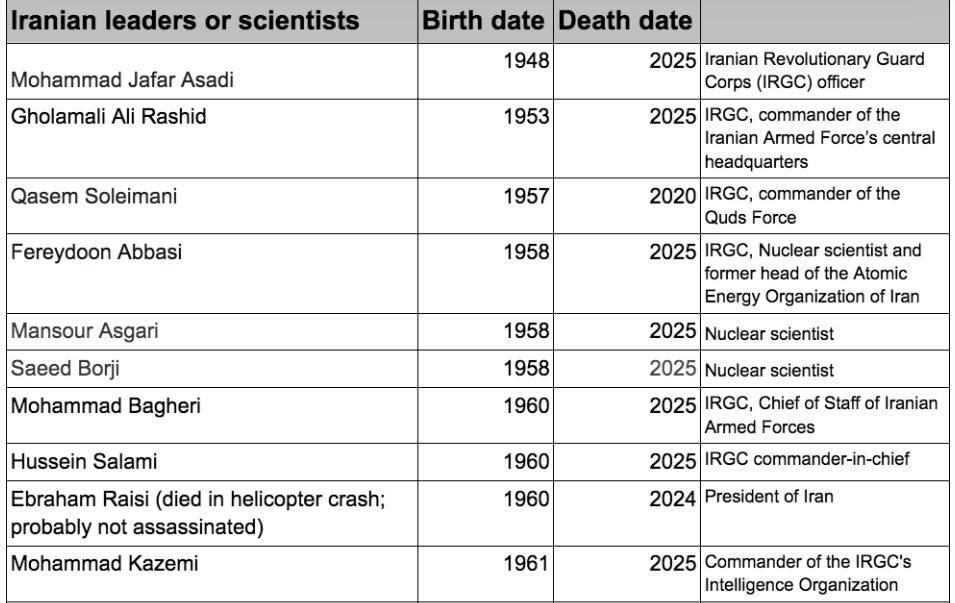
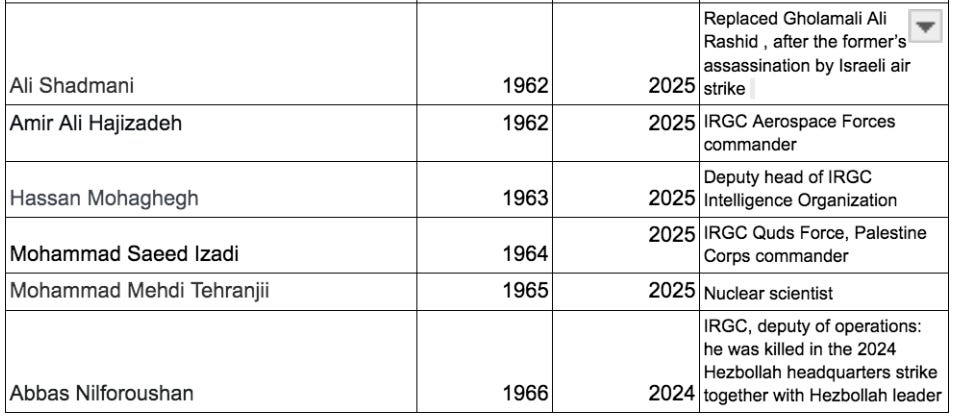
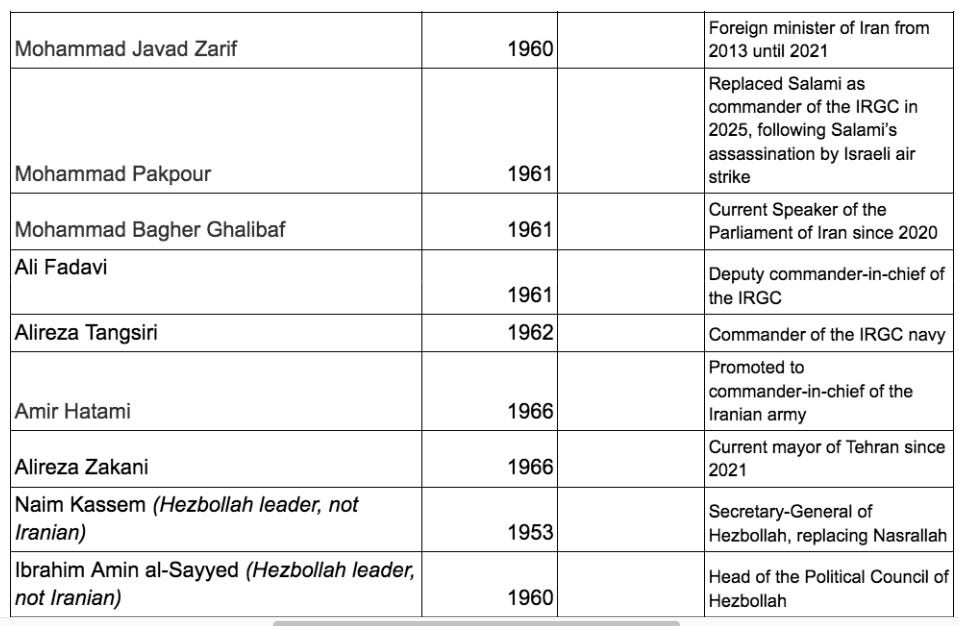
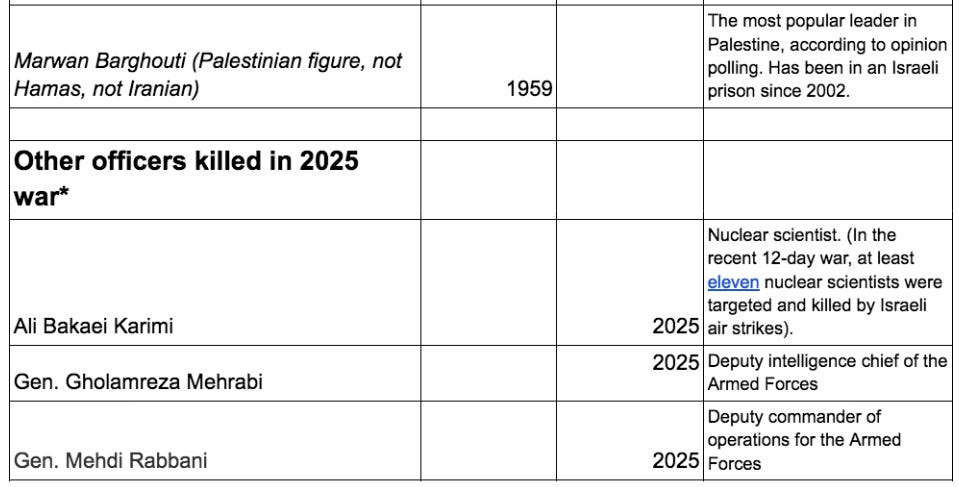
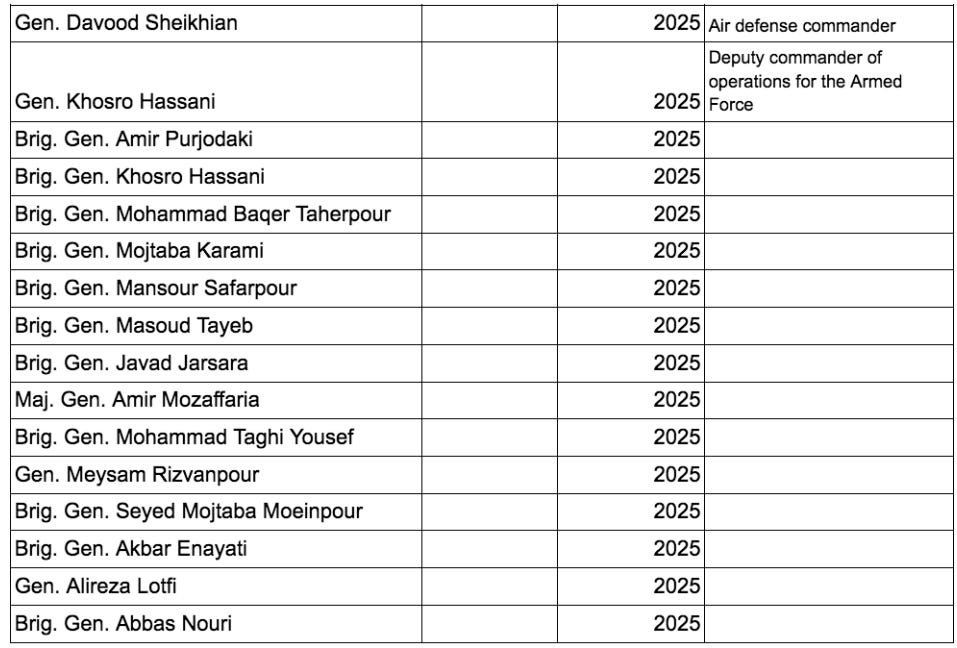
*Source for ‘other officers killed in 2025 war’, whose birth years I could not find: https://southfront.press/iranian-media-names-30-generals-killed-by-israel/
*Mohsen Fakhrizadeh Mahabadi, a nuclear physicist born in 1961 and thought to have been the chief of Iran’s nuclear program, was assassinated in November 2020 by way of a remote-controlled or autonomous satellite-operated roadside gun and bomb, presumably by Israel’s Mossad
*Imad Mughniyeh, the number two man in Hezbollah, was killed less recently than the others on this list: in 2008. Mughniyeh, Sinwar, and Haniyeh were all born in 1962. So too were four or five of the six Hezbollah leaders killed during the same week as Hassan Nasrallah (who was born in 1960). Mughniyeh was 21 years old in 1983 when he planned the Beirut marine barracks and US embassy bombings, for which the CIA or Mossad later assassinated him. Haniyeh, head of Hamas’ political bureau, was assassinated by Israel in Tehran in 2024, on the day Iran’s new president was being sworn in.
Not every recent Iranian leader fought in the Iran-Iraq war in the 1980s, even if they were of age. Ebrahim Raisi, for example, Iran’s president who died in a helicopter crash last year, was born in 1960, but served as a young provincial prosecutor and then deputy prosecutor in Tehran during the war, rather than on the frontlines. During the last year of the war, according to Wikipedia, “Raisi was part of the Tehran branch of what has been called the “1988 Iran death commission“. Under the direction of Grand Ayatollah Khomeini, thousands of Iranian political prisoners were executed by these commissions”, many of whom were members of the People’s Mojahedin Organization of Iran”.
Khamenei, by contrast, was already in his forties during the Iran-Iraq War (as was Saddam Hussein), during which time he served as Iran’s president. He is now, at 86 years old, the same age as his predecessor Khomeini when Khomeini died in 1989, soon after the war ended. Khamenei has been Supreme Leader for 36 years, the longest in power of any current leader of a major country. But he is still a year short of the Shah’s 37 year rule prior to the Shah’s abdication in 1979.
3.
While most of the Iranians targeted by Israel were born around the early 1960s, coming of age during the Iranian Revolution and war with Iraq, much of Iran’s population today was born between the late 1970s and early 1990s, with no direct experience fighting in any wars. These Iranians now represent the bulk of the country’s adult population, as a result of the drop in Iran’s fertility rate a generation ago, from approximately 6.5 children per woman in 1982 (higher than in any country in the world today) to 1.9 children per woman by 2002.
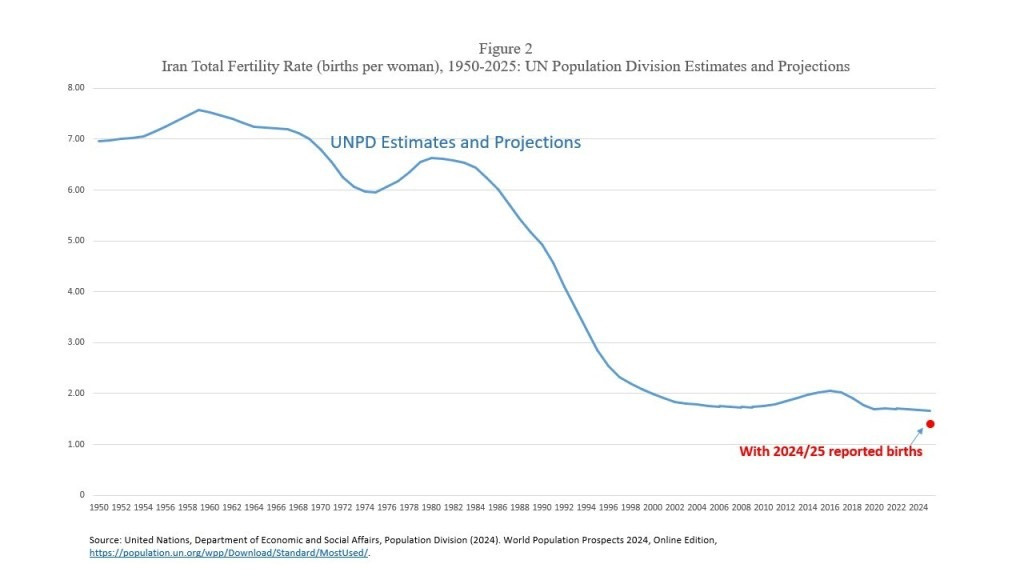
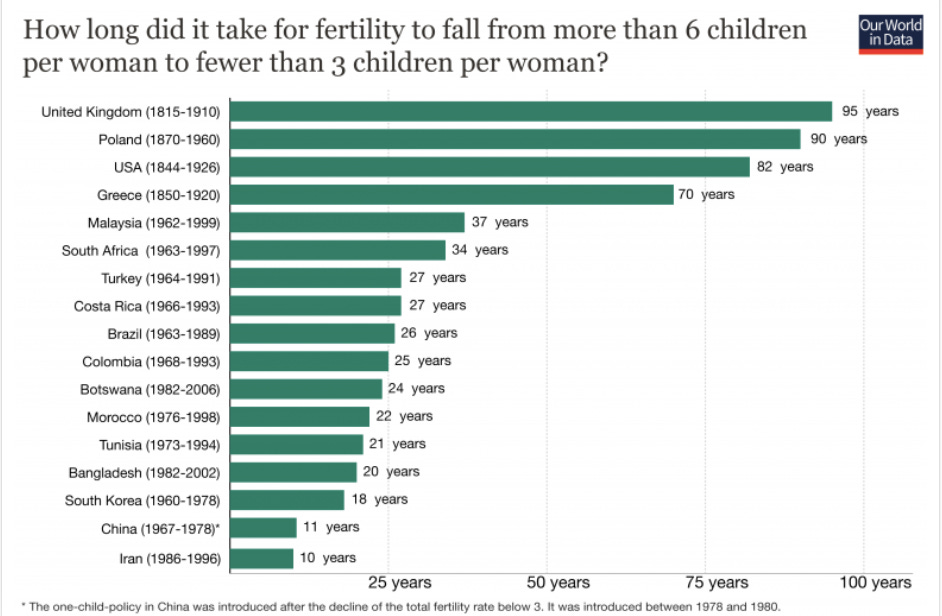
Source: the World Bank; Iran’s fall in fertility in the 1980s and 1990s was roughly as fast as China’s in the 1960s and 1970s (before the one-child policy began in 1979). Iran’s population structure today has similarities to that of China during the late 2000s, with its largest cohort in early middle age.
The graph below, from the World Bank, is of the ‘age dependency ratio‘, the ratio between a country’s working age population (defined as 15-65 years old) and its dependents (defined as anyone under 15 or over 65 years old). As recently as 1990 Iran had a dependency ratio as high as the average among “low-income” countries. Because of Iran’s rapidly falling birth rate, its dependency ratio has since dropped below the average among low-, medium-, and high-income countries.
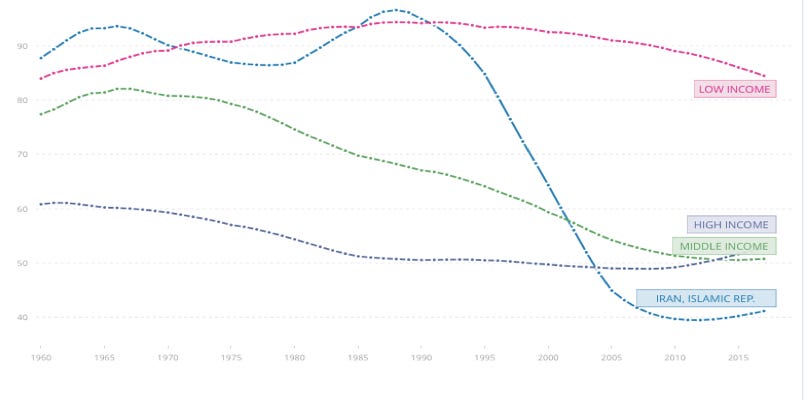
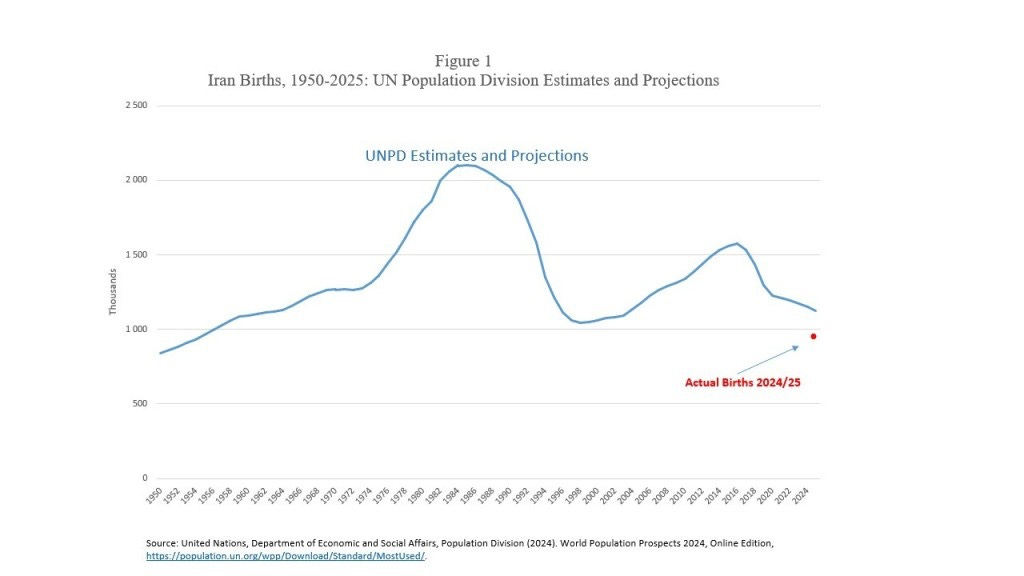
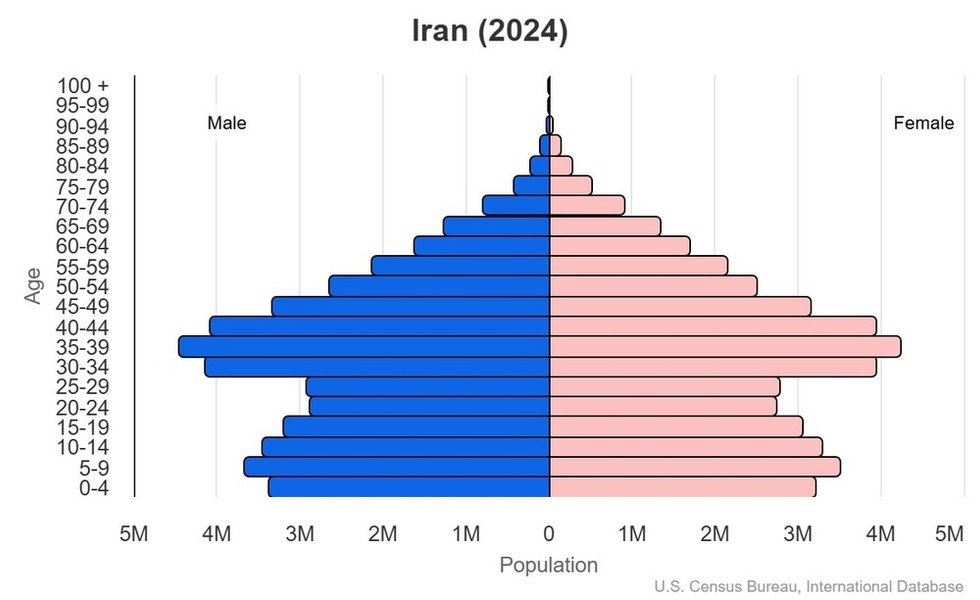
Many Iranians, currently between 30-45 or 30-50 years old, may be entering the most productive economic periods of their lives – if politics allow them to realize their potential. This generation is also well-educated: according to an article by Stefan Trines, “In just a few decades, Iran has transformed from a society with low participation in tertiary education into an exceptionally highly educated one. Between 1999 and 2015 alone, Iran’s tertiary gross enrollment more than tripled from 19.13 percent to 71.9 percent.
Iran’s smaller echo boom generation, born in the 2010s (and peaking around 2017, before declining sharply again), will also come of age during the next decade. As a result Iran will likely have more college-age young adults by the 2030s than it has today, or than it has had at any time since the early 2010s.
At the risk of putting far too much stock into this sort of demographic determinism: a rebound in the size of the student population could perhaps become politically significant. It might not be entirely coincidental for example that the eldest of Iran’s largest generation reached college-age around the time of the 1999 student protests, or that this generation was between about 15-35 years old during the Green Movement a decade later. Even in 2019*, when rising food and gasoline prices following cuts to government subsidies triggered a protest movement, or in 2022-2023 during the Mahsa Amini protests, this largest generation was still relatively young, with the youngest of them in their late twenties.
For now, though, Iran has few 15-30 year olds, as the millennials and GenXers are 30+ and their kids are still kids. Iran’s youth unemployment has been falling from its peak of 29% in 2016 (after the 2000s oil price boom ended in 2015, and as many Iranian millennials were competing with one another upon entering the workforce), but it is still high, at 22.8% according to the World Bank. By comparison, it is 15% in Turkey, in spite of the fact that Turkish women participate in the workforce at more than double the rate of Iranian women.
*According to Wikipedia, “the 2019 uprising, as well as the wider Iranian Democracy Movement in general, differed from earlier protests in 2009 in not being limited to students and large cities, and in the speed, severity and higher death toll of the government crackdown, which crushed the uprising in three days, although protests flared up periodically in the months after.” The number of deaths that occurred as a result of the government’s crackdown against the protesters is contested, but it is commonly estimated to be between 300-1500. If true, this would be a vastly higher figure than even that of the Green Movement protests in 2009, when an estimated 72 people were killed over the course of seven months.
4.
The drop in Iran’s fertility rate stands out even more when viewed alongside some of its next-door neighbours, where, apart from Turkey, Armenia, and Azerbaijan, fertility rates remain higher than almost anywhere outside of Sub-Saharan Africa. Iraq, Pakistan, and Afghanistan especially have high fertility rates; the discrepancy between these countries and Iran is among the highest that exists between any neighbouring states in the world:
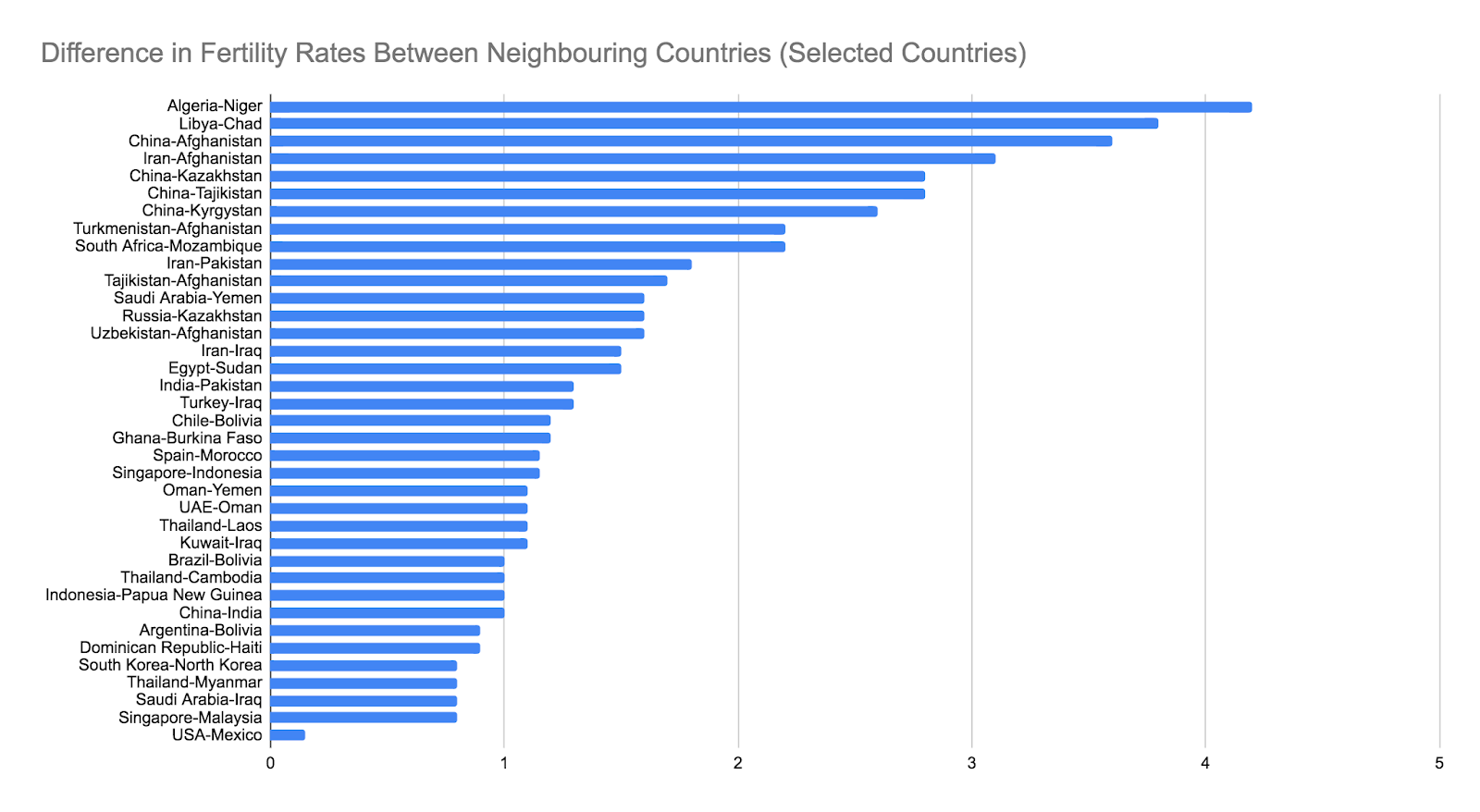
In Afghanistan, women have approximately three more children than Iranian women have on average. The only higher discrepancies that exist between neighbouring countries are in Africa (where Mediterranean states like Algeria directly border Saharan states like Niger) or between China and Afghanistan (which share only a narrow, Himalayan border with one another). But whereas China’s population mostly lives far away from its higher-fertility neighbours in Central Asia and South Asia, many Iranians live close to those regions, making the discrepancy in fertility between Iran and its neighbours even starker. Pakistan for example already has a vastly larger population than Iran, even as its fertility rate remains more than twice as high as Iran’s.
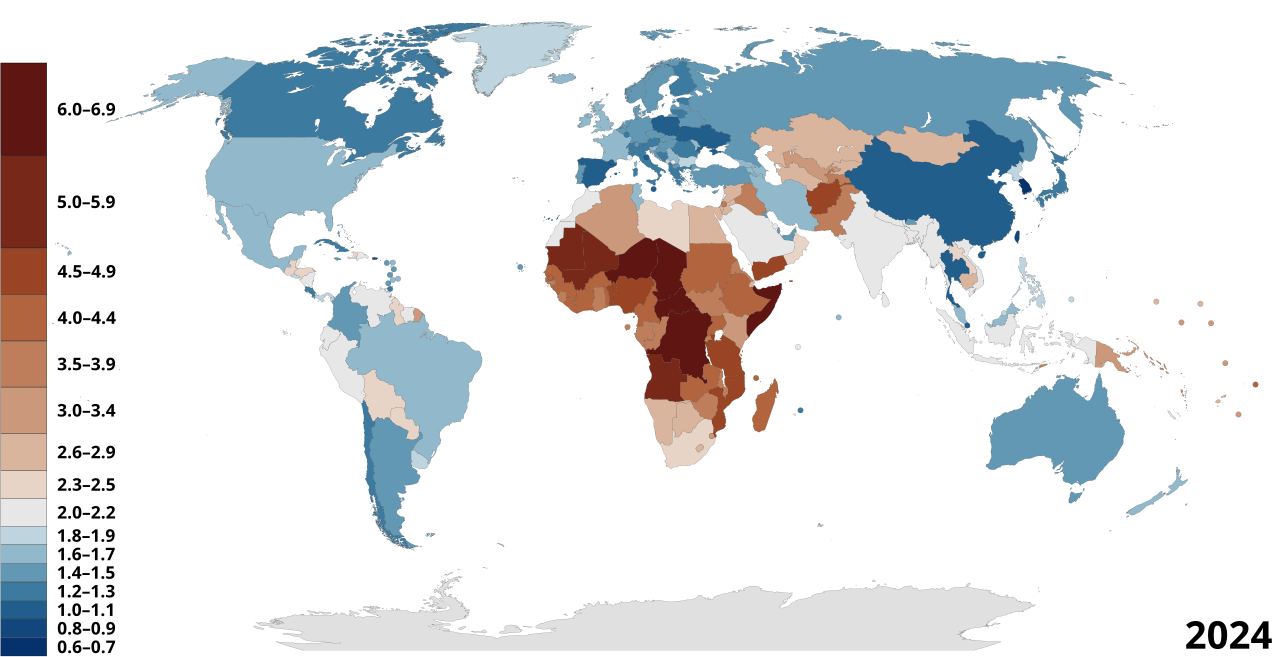
Total fertility rate, Wikipedia. The closest comparison to Iran in this regard is Saudi Arabia, which has a significantly lower fertility rate than its more populous neighbours Yemen, Iraq, and (across the Red Sea) Sudan.
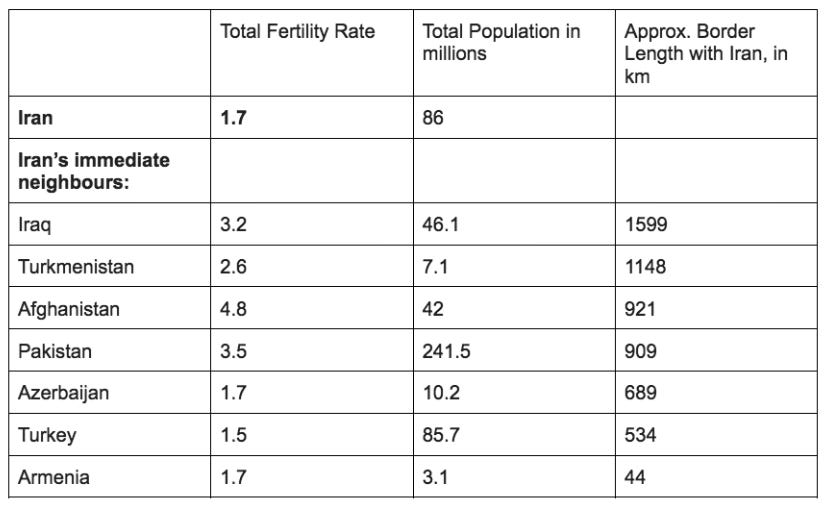
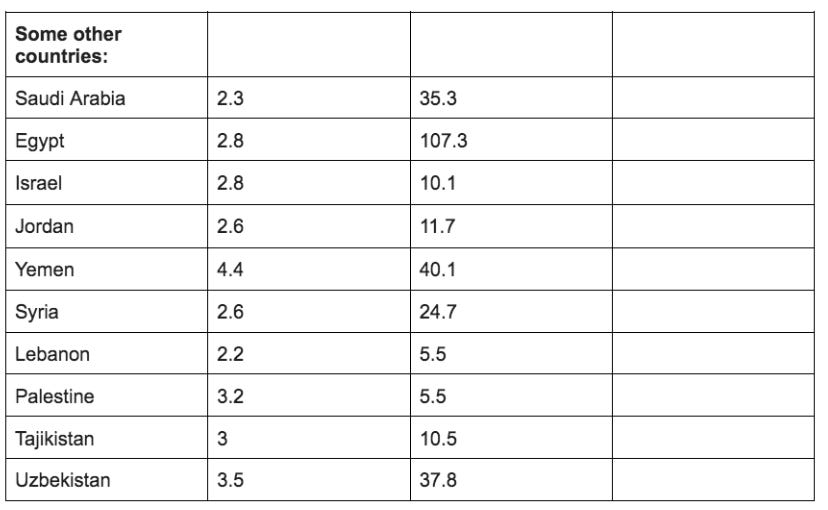
Iran and Afghanistan last had the same fertility rate in 1963, according to the World Bank, when both were still monarchies (the Shah’s White Revolution had just begun) and both had an estimated 7.3 children per woman on average. If current fertility patterns don’t change too much, a generation from now there might be more people who can speak Persian in Afghanistan and Tajikistan than in Iran itself. This could, perhaps, lead to further migration pressures:
5.
The other news in Iran this year has been the deportation of nearly one million Afghan refugees and migrant workers, which had been taking place in the months before Israel and America’s airstrikes and has reportedly intensified since. A similar process has been occurring in Pakistan.
According to Hessam Habibi Doroh, a researcher at Khayrion, “The Afghan migrant community in Iran is estimated at 5-8 million individuals, which amounts to roughly 5.5-8.7% of the total population of c. 92 million. About 2.7 million of these 5-8 million individuals are registered, a bit less than half. Factors such as shared cultural ties, language and the Shi’a identity of the Hazara community, coupled with a relatively open 900-km border, have historically facilitated Afghan migration, while Iran has also tended to function as a transit hub for Afghan migration to Turkey and Europe…Iranian authorities intensified their rhetoric against undocumented Afghan migrants with calls for tougher migration policies and facilitation of forced returns. This sentiment also resonated in political discourse with high-ranking officials such as Parliament Speaker Mohammad Baqer Qalibaf advocating for the construction of a border wall and the closure of Iran’s eastern border, a stance that became a central issue in the 2024 presidential campaign.”
According to the New York Times: “Since March, when Iranian authorities ordered undocumented residents to leave the country, about 800,000 Afghans have poured across the border, Babar Baloch, a spokesman for the United Nations’ refugee agency, said on Monday. Almost 600,000 of them have been forced out since June 1.
During and since the 12-day war between Israel and Iran in June, Iranian officials have repeatedly cast suspicion on Afghans as possible spies for Israel, amplifying longstanding rumors and tensions…Iran has ranked as the world’s biggest host country for refugees, with nearly 3.5 million according to the United Nations, primarily people who fled decades of war and violence in Afghanistan. Aid groups estimate that in reality, the Afghan population in Iran is much larger — including about two million refugees who are undocumented — and Iran’s patience with them appears to have run out.”
According to the Diplomat, “Iran is not acting alone. Since late 2023, Pakistan has intensified its deportation campaign against Afghan nationals. In April alone, more than 135,000 Afghans left Pakistan, followed by approximately 67,000 in May. Pakistan’s “Illegal Foreigners Repatriation Plan” targets undocumented migrants, including long-term resident Afghans and those awaiting resettlement…Turkiye [too] has continued to operate removal centers and conduct charter deportation flights to Kabul throughout 2024. In parallel, it has continued pushbacks along its eastern border with Iran, where Afghan migrants attempting to enter Turkish territory are being systematically forced back.”
6.
The Afghan refugee issue has also been tied to terrorism concerns within Iran, and perhaps has cynically been used by Iran’s government to deflect from domestic political opposition.
Last year the deadliest terror attack in the Islamic Republic’s history occurred. According to Wikipedia, “On 3 January 2024, a commemorative ceremony marking the assassination of Qasem Soleimani at his grave in Kerman, a city in south-eastern Iran, was attacked by two bomb explosions. The attacks killed at least 95 people. The Iranian government declared the bombings a terrorist attack, the deadliest such incident in the country since the Cinema Rex attack of 1978. On the following day, the Islamic State, a Sunni extremist group, claimed responsibility….According to Reuters, the United States Intelligence Community concluded that the attack was perpetrated by the Afghanistan branch of the Islamic State, Islamic State – Khorasan Province.”
Another terror attack – a shooting at the Shah Geragh shrine in Shiraz, in which 13-15 people were killed – occurred on the same day that protests were taking place across the country to commemorate 40 days since the death of Mahsa Amini, in 2022.
According to Kyle Orton, “It’s unclear if the attack was related to the protests. Protests swept through the Islamic Republic following the death of [Amini], the 22-year-old Kurdish Iranian woman who died in police custody after being taken to a “re-education center” for apparently not wearing her hijab properly. It was not that much of a stretch to believe the regime was complicit in such a cynical action. The regime then put out blatant disinformation, blaming the protesters for the attack and trying to implicate Azerbaijan, among other things. This attempt to use the attack to depict peaceful protesters as terrorists directed from outside—exactly as Bashar Asad had—to justify a violent crackdown only furthered the suspicions that the regime had some role in bringing about the attack.”
Earlier in 2022, “a stabbing attack took place at the Imam Reza Shrine in Mashhad, killing two Shia clerics and wounding a third. The perpetrator, identified as foreign national Abdullatif Moradi, a 21-year-old ethnic Uzbek illegal immigrant from Afghanistan, was immediately arrested along with six others accused of assisting him.”
Now of course there has also been the concern that the Israelis, Americans, or Gulf monarchies might have recruited spies or collaborators from minority populations, including Afghans. According to Amwaj media, “Since Israel’s June 13 surprise attack, and continuing after the ceasefire declared on June 24, Iranian authorities have launched a campaign to shore up domestic security. Iran has detained over 700 individuals accused of links to Israel’s Mossad spy agency or collaborating with other hostile states. The crackdown has entailed arrests in border provinces with large minority populations… In the southeastern Sistan-Baluchestan Province [on the borders of Pakistan and Afghanistan], mainly home to the Baluch minority, security forces have killed two suspects and arrested over 50 individuals accused of “terrorist” activities linked to foreign adversaries…Afghan migrants, Iran’s largest immigrant group numbering in the millions, have been swept up in the crackdown with alarming speed. State media have aired confessions of Afghans allegedly involved in espionage and sabotage, prompting the expedited expulsion of members of the community.”
7.
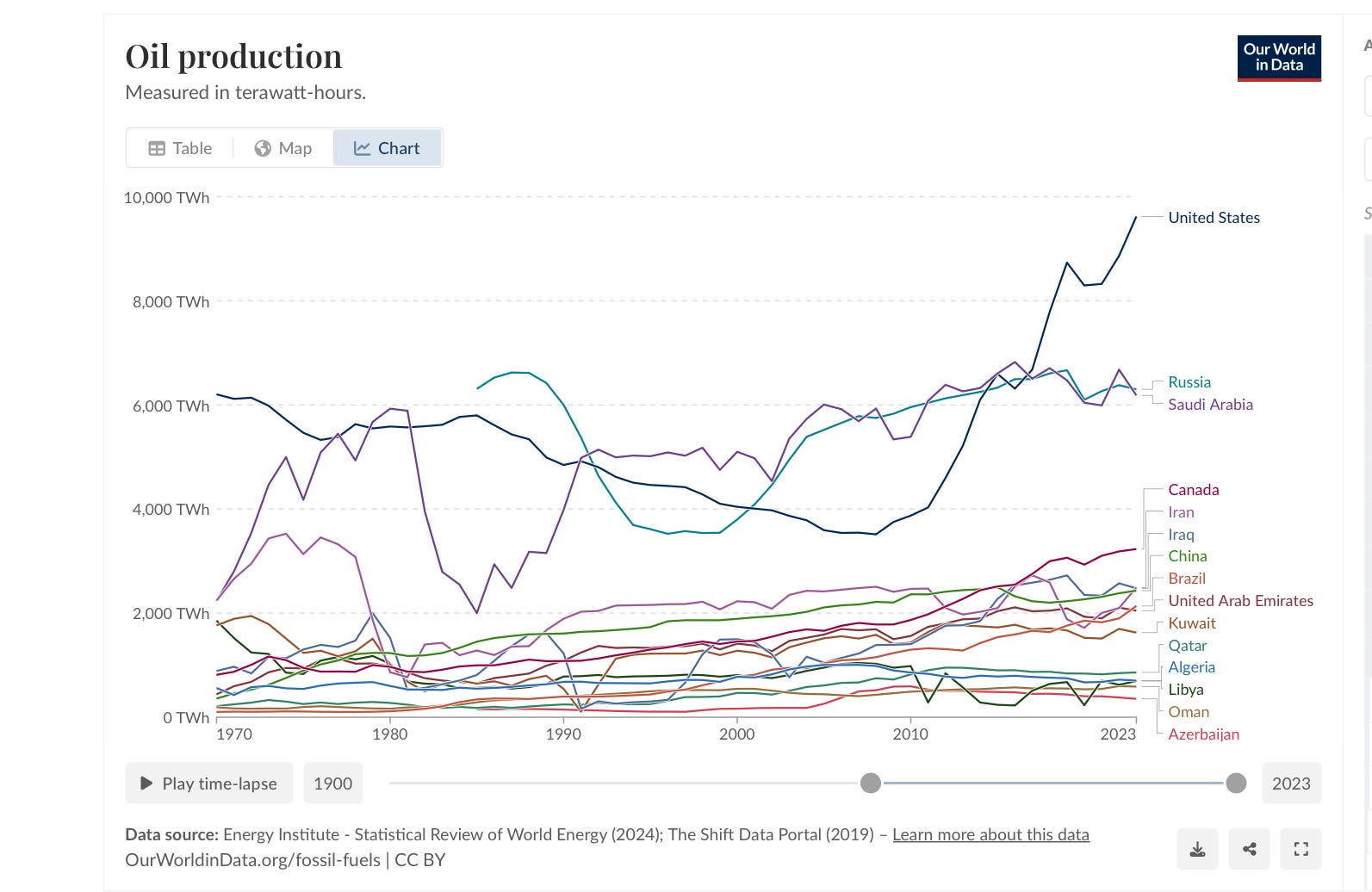
Saudi Arabia, Iran, and Iraq are currently three of the top six oil producers (with the US, Russia, and Canada), the first time they have all been in the top six since the late 1980s (before the First Gulf War) and 1970s (before the Iranian Revolution). The Saudi-Emirati-Kuwaiti alliance continues to lead Gulf production. The wider US alliance, including Canada and the Gulf Arab monarchies, dominates current production.
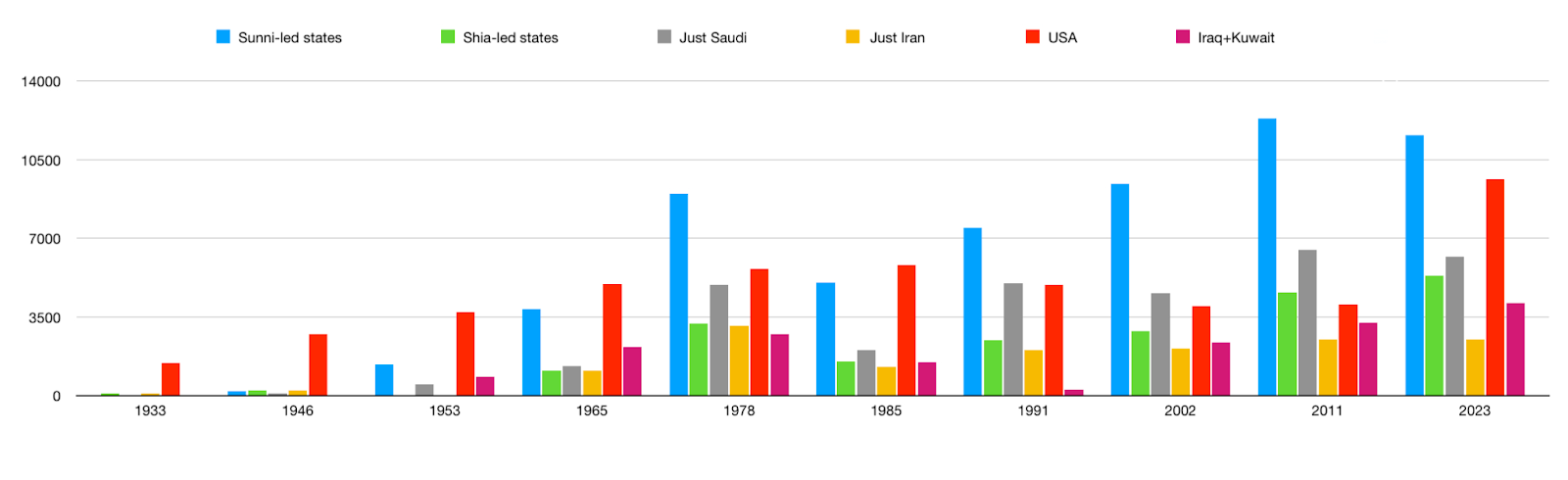
Oil production, US and Mideast countries (ex. North Africa) in twh, select years; Our World in Data
(This graph does not include the US, Russia, or Saudi Arabia, the world’s leading oil producers)
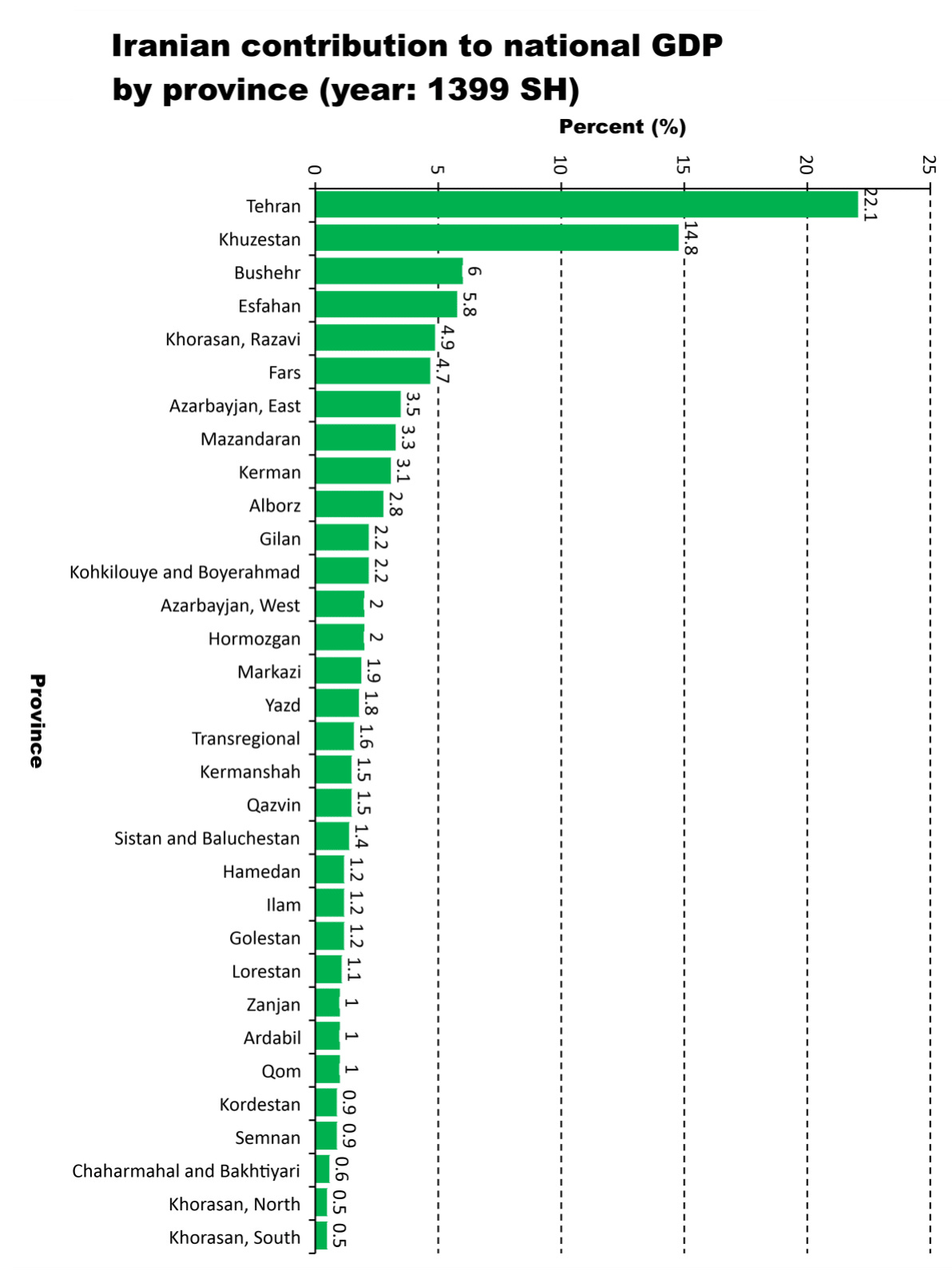
Source: Wikipedia, from the year 2020 (1399 in Iran’s calendar). Apart from Tehran, the capital and largest province by far (approximately 13.5 million inhabitants in 2020), the largest GDP contributor is the Gulf province, Khuzestan (with 4-5 million people, perhaps 30-50 percent of whom are Arabs, the rest split between other minorities and Persians). The next largest, Bushehr (pop. 1-2 million) is also on the Gulf.
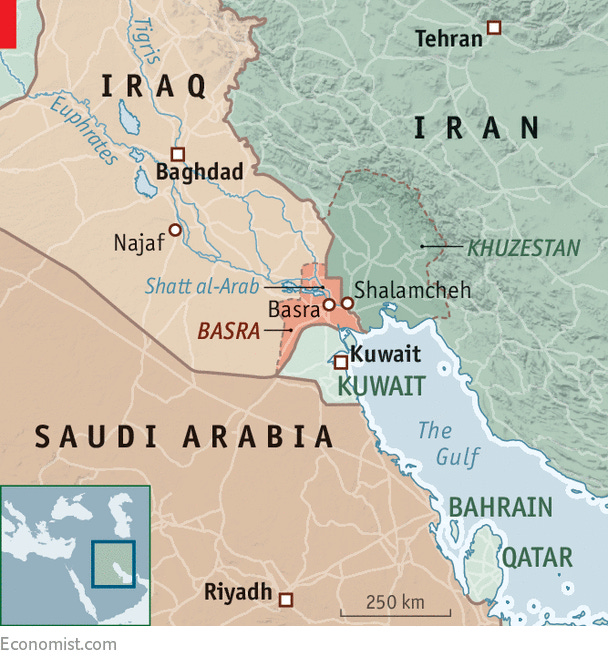
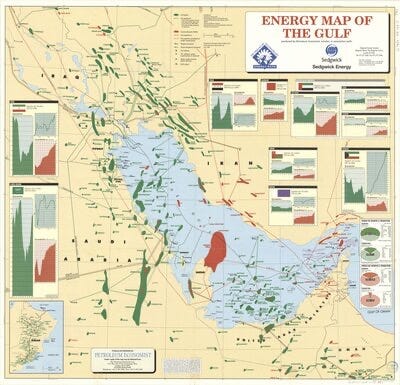

Iraq has (roughly speaking) more than 4/5ths of the Mesopotamian region’s population, but less than half of its oil reserves, and only a sliver of its coastline on the Gulf. It has therefore sometimes been an Iraqi aspiration to expand its current territory—not just for Saddam Hussein, who began the Iran-Iraq War by invading and laying claim to Khuzestan, then annexed Kuwait two years after the war’s end–but also for several previous Iraqi governments, going back to the Hashemite kingdom of Iraq upon its creation in 1932.
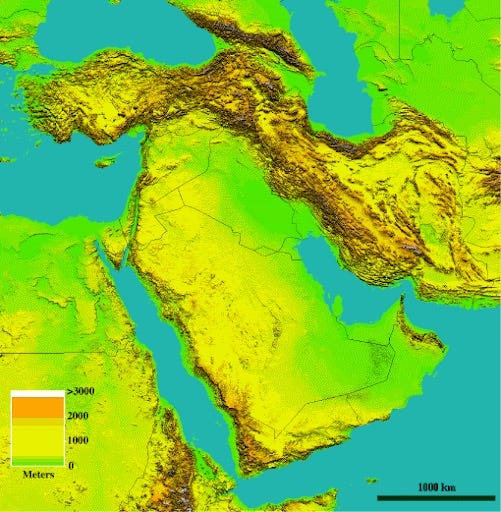
In 1980, a few months before the Iran-Iraq war began, a six-day siege of Iran’s embassy in London was carried out by Iranian Arabs – trained and organized, allegedly, by Iraq – to publicize their demand of sovereignty for Khuzestan. (This occurred during the same time that American hostages were being held in the US embassy in Iran. The famous, failed Delta Force-CIA rescue attempt in Iran ordered by Jimmy Carter had taken place only ten days before the successful SAS raid to end the standoff at Iran’s London embassy).
Also in 1980, the father of Iraq’s current Prime Minister, Mohammed Shia’ al-Sudani, was executed by the Iraqi government along with several other members of his family, for being a member of the Shia Dawa party. Mohammed was nine or ten years old at the time. He later participated in the 1991 Shia and Kurdish uprisings against Saddam Hussein’s government, following Iraq’s loss in the First Gulf War in Kuwait.
8.
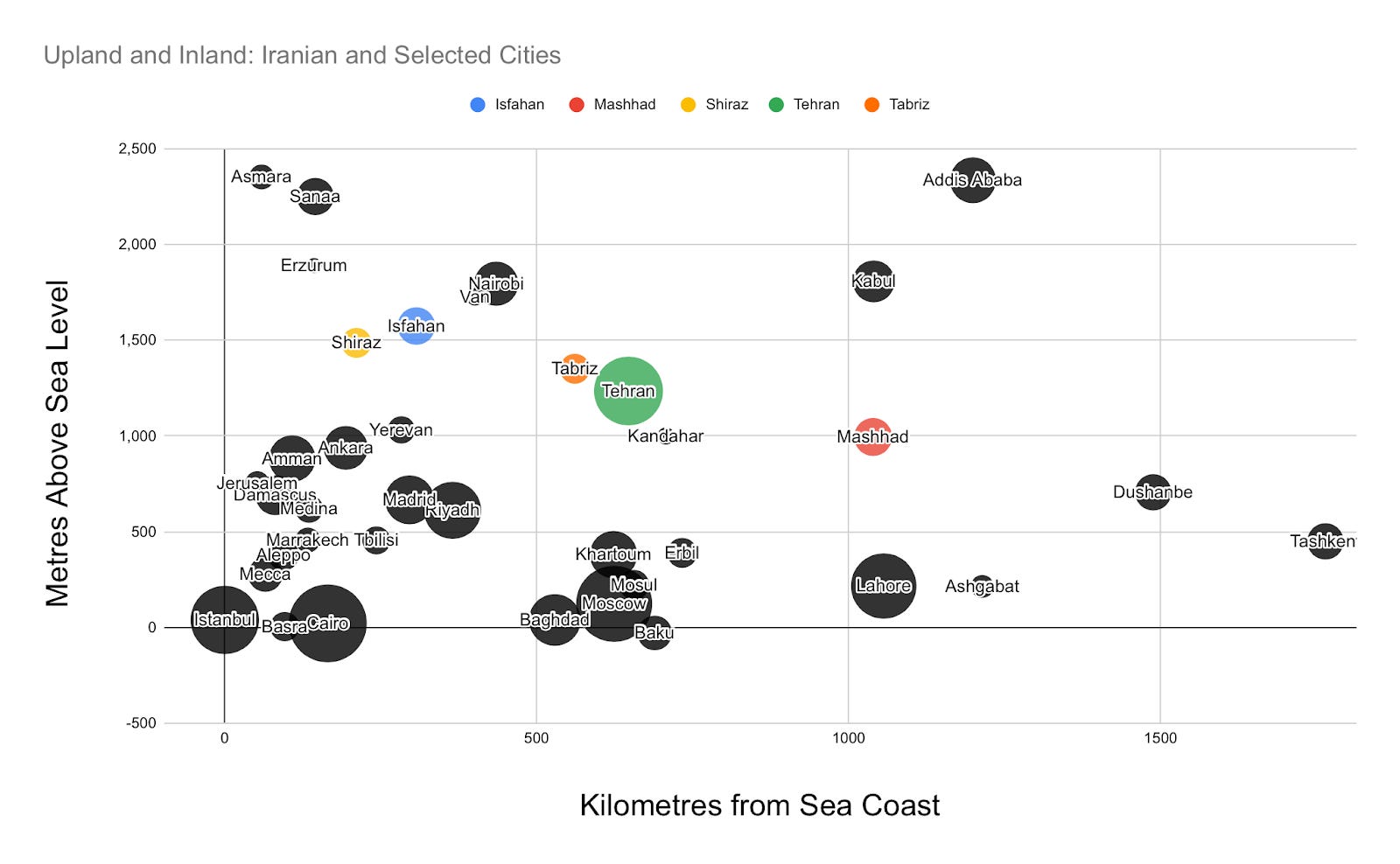
Cities in Iran, the Middle East, and nearby regions; circle size indicates population size. Most of Tehran is between approximately 1100-1600 metres above sea level, as are Iran’s other largest cities. No other cities of Tehran’s size are similar to it in both distance above sea level and distance inland. (There are however a few major cities, like Addis Ababa, that are even higher up and further inland). The elevation mitigates summer heat and increases precipitation. For example, whereas Baghdad–which compared to Tehran is a similar distance inland, but is only 35 metres above sea level–suffers average daily highs of 45 degrees C in its hottest month, and has nightly lows of 4 C in its coldest month, Tehran has average highs of 33-36 C in its hottest month, but nightly lows of -1 in its coldest. And whereas Baghdad gets ~6 inches of rain on average during the year, Tehran gets ~9-17 inches of precipitation (including snow) on average. The ring of mountains surrounding Tehran has however contributed to its having extreme air pollution.
9.
With Russia fighting in Ukraine and Iran and its allies weakened by Israel, Turkey has been able to increase its influence in the region. Turkey’s main rival, the Kurdistan Workers Party (PKK), began disarming itself this summer after forty years of guerilla warfare. In 2023, Turkey’s ally Azerbaijan invaded the contested territory of Nagorno Karabakh, causing nearly the entire population of the territory to flee to Armenia. Turkey also mended ties with Egypt in 2023, which had been strained for a decade after the overthrow of President Morsi of the Muslim Brotherhood, who had been supported by Erdogan’s AKP. Now Turkey and Egypt are on the same sides in Sudan’s civil war (which began in 2023; the UAE has been backing the other side), and, after having taken opposite sides in Libya’s, have been working together to broker a Libyan unity government. And of course, Syria’s Assad government was finally defeated in December 2024, by Turkish-backed forces, who are currently fighting Syrian Kurdish groups.
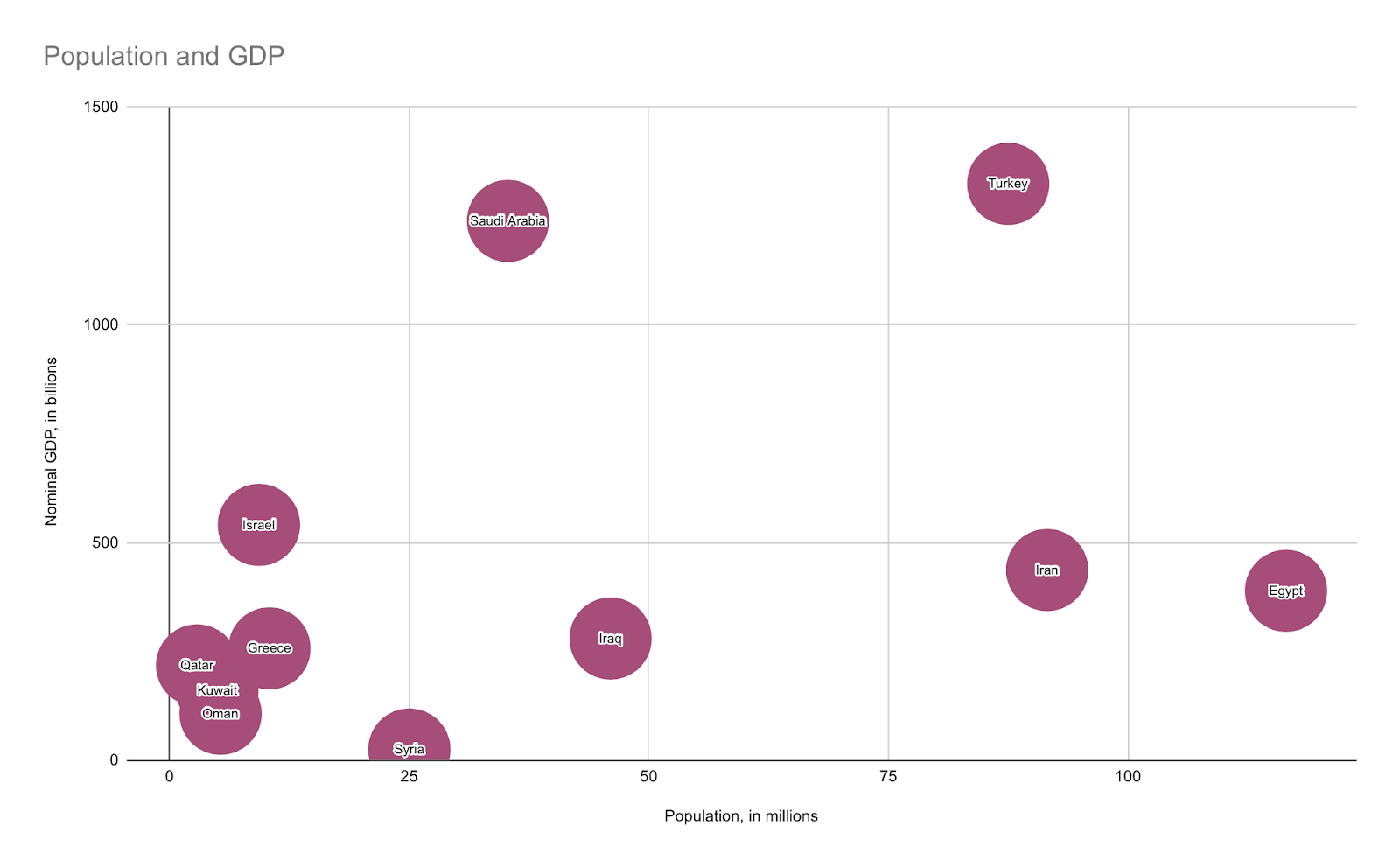
*These figures include non-citizen residents in the Gulf countries, but do not include the non-citizen Palestinian populations in the West Bank and Gaza – approximately 5.3 million people – as part of Israel’s population. The UAE’s label on this chart is obscured by Israel’s, as they have about the same GDP and population size as one another. Turkey has the highest GDP of all Muslim-majority countries, ranking just ahead of Indonesia and Saudi Arabia.
If Russia or Iran continue to weaken, Turkey’s relationships with Israel or Saudi Arabia might worsen. There have been some signs of this already, including this month’s Israeli strikes in the capital of Qatar, Turkey’s primary ally in the Gulf. (When the Saudis and Emiratis blockaded Qatar in 2017, Turkey supported the Qataris). One day before the airstrike in Qatar, Israel attacked multiple sites in Syria, allegedly targeting Turkish missiles and air defense systems in Homs. And in July, in response to fighting between Bedouin and Druze groups in Syria (the latter supported by Israeli Druze, who serve in the Israeli military) Israel carried out strikes in Damascus, hitting the Syrian Presidential Palace and General Staff headquarters, offices of the new government supported by Turkey.
There has been a lot of speculation that Israel will attempt to assassinate Hamas officials in Turkey, if not with airstrikes then by other means, whether covert or – like the Saudis, when they killed Jamal Khashoggi in Istanbul in 2018 – blatant. According to Israel’s Shin Bet, Hamas operatives based in Turkey organized a plot to assassinate Israel’s extremist cabinet minister Itamar Ben Gvir, which was foiled several weeks ago.
“‘After Lebanon, Israel’s next target will be our homeland,’ Erdoğan stated at the opening session of parliament on 1 October 2024”. In March 2025, during the Eid al-Fitr holiday at the end of Ramadan, Erdogan said “‘We see and we know what’s happening in Palestine. May Allah damn Zionist Israel.” (That was two weeks after the start of massacres in Syria by Sunnis of Allawites, in which allegedly 1000-2000 Allawites were killed, the first such event for the new Syrian government which was unable or unwilling to stop them. According to an article in New Lines, “The Alawis in Jableh, a Sunni-majority town, were set upon by HTS’s Unit 400 and the Othman Brigade, another elite HTS outfit, the SNA’s Sultan Suleiman Shah and Hamza Division, and the Uyghur jihadists of the Turkistan Islamic Party —all units publicly loyal to the Syrian Ministry of Defense. At least seventy-seven Alawis were killed”. Othman and Suleiman Shah are named for the Ottoman Empire’s founder and and his grandfather, respectively). Later, during the war between Israel and Iran in June 2025, Erdogan announced plans to build out Turkey’s supply of ballistic missiles to “deterrent level”.
When the US removed Saddam Hussein’s government after 9-11, it intensified Iran’s conflicts with Israel and Saudi Arabia. Now, similarly, if the US and its allies are able to continue weakening Iran and Russia, or perhaps even succeed in flipping Iran back into an ally against Russia (as it was pre-1979), it might lead to future conflicts with Turkey.
*Azerbaijanis, by contrast, do share a mutually intelligible language with most of Turkey’s population and with the large Turkic minorities in both Iran and Iraq, but have their own country and so are usually considered to be their own separate group. Similarly, Persian in Iran is thought to be basically mutually intelligible with Tajik in Tajikistan and with Dari, one of Afghanistan’s main languages. Finally, some groups are more similar to one another than others even when their languages aren’t mutually intelligible. Persian and Kurdish for instance are considered part of the same family of languages, unlike Arabic or Turkish. Arguably, Persian is significantly more similar to Kurdish than, for example, French is to Spanish.
I got carried away with this note section — it goes on for a while longer. So I’m moving the rest of the notes to a separate post: https://thegeographicinvestor.com/2026/01/06/iran-additional-additional-notes/
 thegeographicinvestor.com